

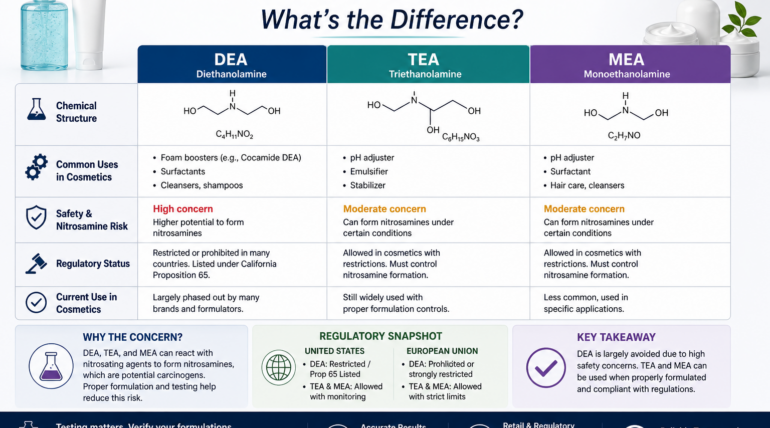
Ingredients like DEA, TEA, and MEA are commonly used in cosmetic and personal care formulations. However, they are often misunderstood—and increasingly scrutinized.
So what’s the difference between them, and why does it matter?
What Are DEA, TEA, and MEA?
DEA, TEA, and MEA are all part of a group of compounds called alkanolamines, which are used in cosmetics to adjust pH, stabilize formulations, and improve texture.
- Diethanolamine (DEA)
- Triethanolamine (TEA)
- Monoethanolamine (MEA)
Although they are chemically related, their function, safety profile, and regulatory treatment differ significantly.
Key Differences Between DEA, TEA, and MEA
| Property | DEA | TEA | MEA |
|---|---|---|---|
| Full Name | Diethanolamine | Triethanolamine | Monoethanolamine |
| Common Use | Foam boosters, surfactants | pH adjuster, emulsifier | pH adjuster, surfactant |
| Regulatory Scrutiny | High | Moderate | Moderate |
| Nitrosamine Risk | High | Moderate | Moderate |
| Typical Use Today | Largely phased out | Still widely used | Less common |
What Is DEA Used For?
DEA is commonly used in:
- Foam boosters (e.g., Cocamide DEA)
- Cleansers and shampoos
- Industrial and cleaning products
However, DEA is now heavily restricted due to its potential to form nitrosamines, which are associated with cancer risk.
As a result:
- Many brands have eliminated DEA entirely
- Retailers often restrict DEA-containing products
- Testing is frequently required for compliance
What About TEA?
TEA is still widely used in cosmetics, especially as a:
- pH adjuster
- Emulsifier
- Stabilizer
Compared to DEA:
- TEA is considered safer when properly formulated
- However, it can still form nitrosamines under certain conditions
Therefore, TEA is regulated but not broadly banned. Its safety depends on:
- Concentration
- Formulation controls
- Absence of nitrosating agents
What About MEA?
MEA is less commonly used in cosmetics but may appear in:
- Hair care products
- Cleansers
- Industrial formulations
Like TEA:
- MEA carries some nitrosamine risk
- It is subject to regulatory limits and formulation controls
However, it is generally used less frequently than TEA in modern cosmetic formulations.
Why Are These Ingredients a Concern?
The primary concern with DEA, TEA, and MEA is their ability to form nitrosamines.
Nitrosamines are:
- Potential carcinogens
- Formed when amines react with nitrosating agents
- Heavily monitored by regulators and retailers
Because of this:
- DEA is largely avoided
- TEA and MEA are controlled more carefully
- Testing is often recommended to verify safety
Regulatory Overview
United States
- DEA is listed under California Proposition 65
- TEA and MEA are allowed but monitored
- Manufacturers are responsible for ensuring product safety
European Union
Under the EU Cosmetics Regulation:
- DEA is restricted or prohibited in cosmetic use
- TEA and MEA are allowed with strict conditions
- Nitrosamine formation must be controlled
Which One Should You Use?
From a formulation and compliance perspective:
- Avoid DEA whenever possible
- Use TEA cautiously with proper formulation controls
- Use MEA selectively, depending on product type
Most modern formulations favor:
- DEA-free systems
- Alternative surfactants and emulsifiers
- Safer pH adjustment strategies
Do You Need Testing for DEA, TEA, or MEA?
Testing may be necessary if:
- Your formulation includes ethoxylated ingredients
- You are selling through retailers like Amazon
- Your product is flagged for compliance review
- You want to verify absence of DEA contamination
In many cases, brands test for:
- DEA specifically
- Nitrosamines (when risk is present)
- Broader chemical screening panels
Final Thoughts
DEA, TEA, and MEA may sound similar—but they are not interchangeable.
- DEA is largely phased out due to safety concerns
- TEA remains widely used but controlled
- MEA is less common but still relevant in certain formulations
Understanding these differences helps ensure:
- Regulatory compliance
- Retail acceptance
- Product safety
Need Help with DEA or Nitrosamine Testing?
Pentyl Labs supports cosmetic testing for DEA and related compounds, helping brands meet retailer and regulatory requirements.

