

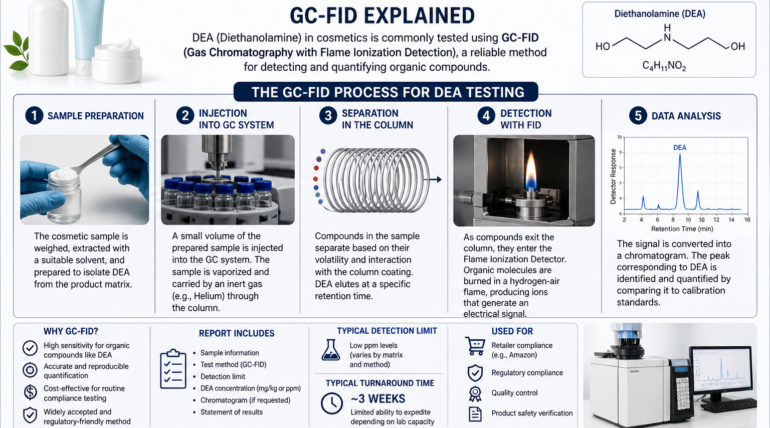
DEA testing GC-FID is one of the most common analytical approaches used to detect and quantify diethanolamine (DEA) in cosmetics and personal care products. GC-FID (Gas Chromatography with Flame Ionization Detection) allows laboratories to evaluate DEA content in shampoos, cleansers, soaps, creams, and related formulations for regulatory, retailer, and quality purposes.
Why DEA Testing Is Required
DEA is not always intentionally added to cosmetics. However, it may be present due to:
- Raw material contamination
- Manufacturing processes
- Degradation of certain ingredients
Because DEA is associated with nitrosamine formation, retailers and regulators often require testing to confirm its absence or quantify trace levels.
What Is GC-FID?
GC-FID (Gas Chromatography–Flame Ionization Detection) is an analytical technique used to separate and measure organic compounds.
It is commonly used in cosmetic testing because:
- It is highly sensitive to organic molecules like DEA
- It provides reliable quantification
- It is well-suited for routine compliance testing
How GC-FID Works (Simplified)
The GC-FID process can be broken down into a few key steps:
1. Sample Preparation
The cosmetic sample is:
- Diluted or extracted
- Filtered if necessary
- Prepared to isolate DEA from the product matrix
This step is critical for complex formulations like creams or gels.
2. Injection into the GC System
A small portion of the prepared sample is injected into the GC instrument.
Inside the system:
- The sample is vaporized
- Carried through a column by an inert gas (e.g., helium or hydrogen)
3. Separation in the Column
As the sample moves through the column:
- Different compounds separate based on volatility and interaction with the column coating
- DEA elutes at a specific retention time
This allows it to be distinguished from other ingredients.
4. Detection with FID
When compounds exit the column:
- They enter a flame ionization detector
- Organic molecules are burned in a hydrogen-air flame
- This produces ions that generate an electrical signal
The signal is proportional to the amount of DEA present.
5. Data Analysis
The instrument produces a chromatogram, which shows peaks corresponding to different compounds.
For DEA:
- The peak area is measured
- Compared against calibration standards
- Converted into a concentration value
What Does a DEA Test Report Include?
A typical DEA test report includes:
- Sample identification
- Test method (e.g., GC-FID)
- Detection limit
- Quantitative result (e.g., mg/kg or ppm)
- Chromatogram (in some cases)
- Statement of results
This documentation is often used for:
- Retail compliance (e.g., Amazon)
- Internal quality control
- Regulatory submissions
Detection Limits and Sensitivity
GC-FID is capable of detecting low levels of DEA, typically in the:
- ppm (parts per million) range
Actual detection limits depend on:
- Sample matrix
- Preparation method
- Instrument calibration
For compliance purposes, labs often tailor detection limits to retailer or regulatory expectations.
Why GC-FID Is Used for DEA Testing
GC-FID is widely used because it offers:
- ✔ Reliable quantification
- ✔ Good sensitivity for organic compounds
- ✔ Cost-effective routine testing
- ✔ Established method acceptance
While more advanced techniques (like GC-MS) may be used for confirmation, GC-FID remains a practical and effective primary method.
What Can Impact DEA Test Results?
Several factors can affect accuracy and turnaround:
- Complex formulations (e.g., emulsions, waxes)
- Interfering compounds
- Sample preparation quality
- Calibration accuracy
Working with a lab experienced in cosmetic matrices is key to obtaining reliable results.
How Long Does DEA Testing Take?
Typical turnaround times for DEA testing using GC-FID are:
- Standard: ~3 weeks
- Limited ability to expedite depending on capacity
Turnaround depends on:
- Sample volume
- Method complexity
- Lab workload
Final Thoughts
DEA testing using GC-FID is a proven, reliable method for ensuring cosmetic products meet compliance expectations.
By understanding how the method works, brands can:
- Better interpret results
- Prepare for retailer requirements
- Reduce compliance risks
Need DEA Testing Support?
Pentyl Labs provides GC-FID-based DEA testing for cosmetics, supporting retail compliance and product safety verification.
[email protected]
www.pentyllabs.com

