
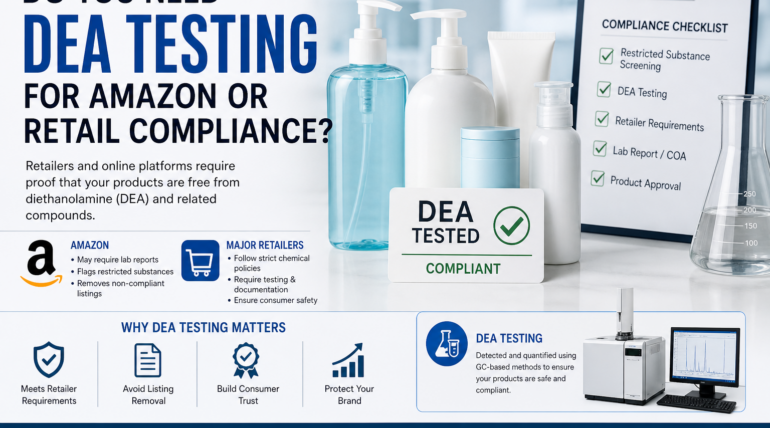
If you’re selling cosmetics, personal care, or cleaning products, DEA testing is quickly becoming a requirement—not a nice-to-have.
Retailers and online platforms are tightening chemical safety standards. As a result, brands must prove that their products are free from restricted substances like Diethanolamine (DEA).
So, do you actually need DEA testing for Amazon or retail compliance?
In many cases, the answer is yes.
Why DEA Is a Concern for Retailers
DEA and DEA-related compounds (such as Cocamide DEA) are under scrutiny because they can form nitrosamines, which are associated with potential cancer risk.
Because of this:
- Regulators monitor DEA levels
- Retailers restrict or flag DEA-containing products
- Consumers are increasingly aware of “DEA-free” claims
Therefore, even trace contamination can create compliance issues.
Amazon and Retailer Requirements
Amazon
Amazon has implemented strict product safety and compliance policies, especially for:
- Cosmetics
- Personal care products
- Baby products
- Cleaning formulations
In many cases, Amazon may:
- Request third-party lab reports
- Flag listings for restricted substances
- Remove or suppress non-compliant products
If DEA or related compounds are suspected, testing documentation is often required to reinstate listings.
Other Major Retailers
Large retailers such as:
- Walmart
- Target
also maintain restricted substance lists (RSLs).
As a result, they may require:
- Chemical screening data
- Certificates of analysis (COAs)
- Supplier compliance documentation
Without proper testing, your product may never make it onto shelves.
When Do You Need DEA Testing?
You should strongly consider DEA testing if your product:
1. Contains Ethoxylated Ingredients
Ingredients like:
- SLES (Sodium Laureth Sulfate)
- PEG compounds
- Polysorbates
can introduce trace DEA or 1,4-dioxane contamination during manufacturing.
2. Uses Foam Boosters or Surfactants
Products containing:
- Cocamide DEA
- Cocamide MEA/TEA
- Other amide-based surfactants
carry a higher compliance risk.
3. Is Flagged by a Retailer
If Amazon or another retailer requests documentation, you will likely need:
- DEA testing
- Supporting analytical data
- A formal lab report
4. Is Entering Retail for the First Time
If you are launching into:
- Amazon
- Big box retail
- International markets
testing upfront helps avoid delays, rejections, or costly reformulations.
What Happens If You Don’t Test?
Skipping DEA testing can lead to:
- ❌ Product listing removal
- ❌ Delayed product launches
- ❌ Retail rejection
- ❌ Regulatory scrutiny
- ❌ Brand reputation damage
In contrast, having validated test data gives you:
- Faster approvals
- Stronger retailer confidence
- Fewer compliance surprises
How DEA Testing Is Performed
DEA testing typically uses gas chromatography (GC-based methods) to detect and quantify diethanolamine in finished products.
Testing may include:
- Raw material screening
- Finished product analysis
- Contamination risk evaluation
Depending on your product, labs may also recommend:
- Nitrosamine testing
- Broader chemical screening panels
How Much Testing Do You Need?
This depends on your product and retail goals.
For example:
- Single SKU Amazon launch → Basic DEA screening
- Retail rollout (multiple SKUs) → Full compliance panel
- High-risk formulations → DEA + nitrosamines + additional contaminants
A targeted approach helps control cost while still meeting requirements.
Final Thoughts
DEA testing is no longer optional for many brands—it’s a key part of retail compliance.
If you’re selling on Amazon or targeting major retailers, having validated DEA test results can mean the difference between:
- Getting listed
- Or getting rejected
Need DEA Testing Support?
Pentyl Labs provides fast, retail-aligned DEA testing for cosmetics and consumer products.
We support:
- Amazon compliance documentation
- Retailer submission requirements
- Rapid turnaround testing
📩 Contact: [email protected]
🌐 www.pentyllabs.com

