

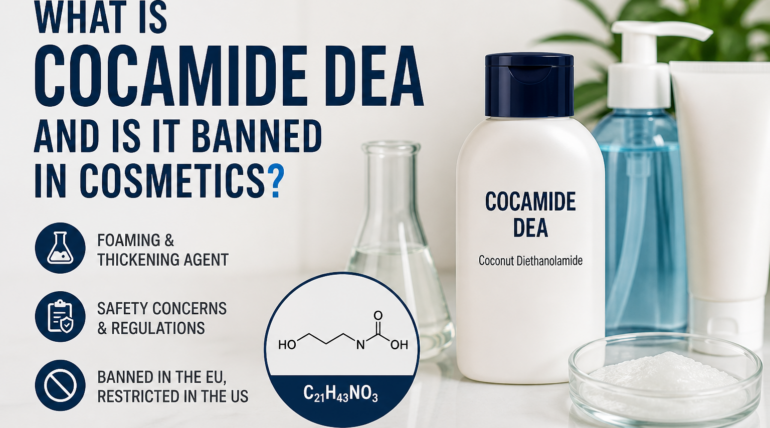
What Is Cocamide DEA and Is It Banned in Cosmetics?
Cocamide DEA is a common ingredient in shampoos, body washes, and liquid soaps. However, in recent years, it has faced increasing scrutiny from regulators, retailers, and consumers.
So, what is Cocamide DEA—and is it banned in cosmetics?
What Is Cocamide DEA?
Cocamide DEA (Coconut Diethanolamide) is a surfactant derived from coconut fatty acids and Diethanolamine (DEA).
It is widely used in cosmetic formulations because it can:
- Boost foam in cleansers
- Stabilize lather
- Thicken formulations
- Improve texture and consistency
As a result, manufacturers historically relied on Cocamide DEA in many rinse-off products.
Why Is Cocamide DEA a Concern?
Cocamide DEA raises safety concerns due to its potential to form nitrosamines, which are harmful compounds.
Specifically, when DEA-containing ingredients react with certain substances, they may form N-nitrosodiethanolamine (NDEA). This compound is classified as a potential carcinogen.
Therefore, even if Cocamide DEA itself is not directly added in large amounts, its presence can still pose a risk under certain conditions.
Is Cocamide DEA Banned?
United States
In the United States, Cocamide DEA is not completely banned. However, it is heavily restricted.
For example:
- It is listed under California Proposition 65
- Products may require warning labels in California
- Many companies have reformulated products to avoid it
As a result, its use has significantly declined.
European Union
In contrast, the European Union has taken a stricter approach.
Under the EU Cosmetics Regulation, Cocamide DEA is effectively prohibited in cosmetic products.
Therefore, it cannot be used in cosmetics sold within the EU.
Retailer Policies
In addition to government regulations, major retailers enforce their own chemical restrictions.
For instance:
- Amazon
- Walmart
- Target
These companies often restrict or flag products containing Cocamide DEA.
Consequently, brands may face listing challenges even if the ingredient is technically allowed.
Where Is Cocamide DEA Found?
Although its use is declining, Cocamide DEA may still be found in:
- Older formulations
- Low-cost or imported products
- Certain industrial cleaning products
Most commonly, it appears in rinse-off products rather than leave-on cosmetics.
How Do You Test for Cocamide DEA?
Testing for Cocamide DEA typically focuses on detecting:
- Residual DEA content
- Nitrosamine formation potential
- Raw material contamination
Common analytical techniques include:
- GC-based methods for DEA detection
- Targeted nitrosamine analysis
Because of regulatory pressure, many brands now test for DEA even when it is not intentionally added.
Should You Avoid Cocamide DEA?
In most cases, yes.
Today, Cocamide DEA presents several challenges:
- Regulatory risk
- Retail compliance issues
- Negative consumer perception
Therefore, most brands have transitioned to safer alternatives such as:
- Cocamidopropyl betaine (CAPB)
- Non-DEA surfactants
- Modern sulfate-free systems
Final Thoughts
Cocamide DEA was once widely used in cosmetic formulations. However, due to safety concerns and regulatory pressure, it has largely been phased out.
Ultimately, brands that want to ensure compliance and maintain consumer trust should avoid Cocamide DEA and monitor for DEA contamination.

