
What Is 1,4-Dioxane?
1,4-Dioxane is a trace contaminant that forms during the manufacturing of certain ingredients. In particular, it develops during the ethoxylation process used to create surfactants found in cosmetics, personal care, and cleaning products.
Although manufacturers do not intentionally add it, it can still appear as a byproduct in ingredients such as:
- Sodium laureth sulfate (SLES)
- PEG compounds
- Polysorbates
- Laureth-based surfactants
Because regulators classify 1,4-dioxane as a probable human carcinogen, they continue to increase scrutiny and tighten limits.
Where Is 1,4-Dioxane Found?
1,4-Dioxane can appear in a wide range of everyday products. For example:
Cosmetics and Personal Care
- Shampoos and conditioners
- Body washes and facial cleansers
- Lotions and creams
- Baby care products
Household and Cleaning Products
- Laundry detergents
- Dish soaps
- All-purpose cleaners
- Industrial and institutional formulations
Importantly, many brands focus only on cosmetics. However, cleaning products often carry the same risk.
New York Regulations: Strict Limits Now in Effect
New York State now enforces strict limits on 1,4-dioxane in consumer products. As a result, compliance has become a critical requirement.
Current Limits
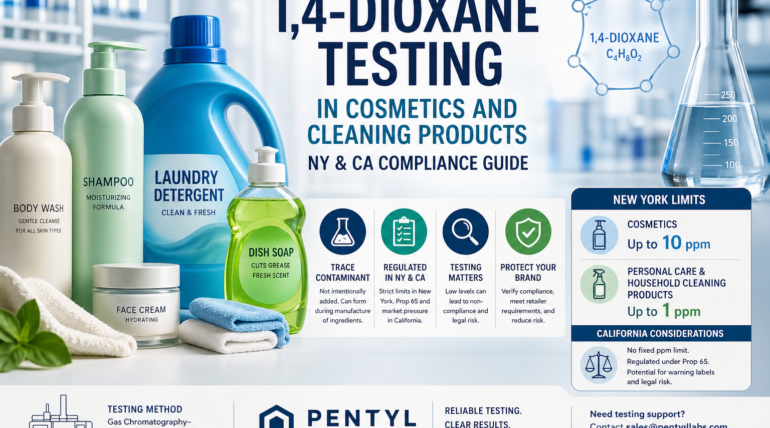
- Cosmetics: up to 10 ppm
- Personal care and household cleaning products: up to 1 ppm
These limits apply to products sold in New York. Therefore, brands must verify compliance before distribution.
What This Means for Brands
These regulations directly impact formulation and quality control. Specifically:
- Even trace contamination can make a product non-compliant
- Suppliers must control or verify residual levels
- Testing often becomes the only reliable way to confirm compliance
In particular, products containing ethoxylated surfactants carry the highest risk. Therefore, these formulations require closer attention.
California Considerations (Prop 65 and Market Pressure)
Unlike New York, California does not set fixed ppm limits. However, 1,4-dioxane still creates regulatory and legal risk under Proposition 65.
Key considerations include:
- Exposure-based risk assessments
- Potential warning label requirements
- Increasing scrutiny from regulators and retailers
As a result, products with detectable levels may trigger compliance issues. Consequently, many companies now test proactively to reduce risk.
Why Brands Are Testing Now
Testing demand continues to increase. This shift is driven by several factors:
- State regulations, especially in New York
- Retailer requirements such as Amazon and major CPG buyers
- Supply chain transparency expectations
- Litigation and compliance risk
Because of these pressures, testing has moved from optional to expected.
How Is 1,4-Dioxane Testing Performed?
Laboratories typically analyze 1,4-dioxane using Gas Chromatography–Mass Spectrometry (GC-MS).
To ensure accurate results, labs must address several factors:
- Low detection limits to meet 1 ppm thresholds
- Differences between cosmetic and detergent matrices
- Proper sample preparation and extraction
Therefore, validated methods and experienced laboratories are essential.
How Pentyl Labs Supports Compliance
Pentyl Labs helps brands navigate 1,4-dioxane requirements with clear and reliable testing solutions.
Capabilities
- Testing aligned with New York regulatory thresholds
- Support for cosmetics, personal care, and household products
- Access to ISO/IEC 17025 accredited partner laboratories
- Clear, defensible reporting for regulatory and retailer needs
Typical Turnaround Time
Approximately 3 weeks
Use Cases
- Product compliance verification
- Supplier qualification
- Retailer submission requirements
- Risk assessment and reformulation support
When Should You Test?
Testing is strongly recommended if your product:
- Contains ethoxylated ingredients such as PEGs, laureths, or polysorbates
- Is sold or distributed in New York State
- Targets major retail placement
- Requires regulatory or legal risk mitigation
Get Started with 1,4-Dioxane Testing
Regulatory compliance continues to evolve. However, managing your risk does not have to be complicated.
Pentyl Labs can help you:
- Understand your risk
- Verify compliance
- Deliver defensible results
Contact [email protected] to request a quote or discuss your testing needs.

