

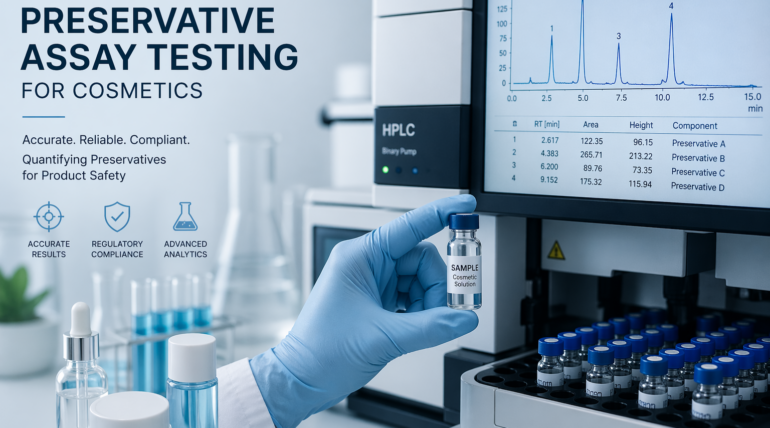
Preservatives are essential for maintaining the safety and stability of cosmetic products. However, simply adding a preservative to a formulation is not enough—its concentration must be verified through analytical testing.
At Pentyl Labs, we provide quantitative preservative assay testing to confirm that your product contains the correct levels of key preservatives such as phenoxyethanol, sodium benzoate, and potassium sorbate.
What Is Preservative Assay Testing?
Preservative assay testing is the quantitative measurement of preservative concentration in a finished cosmetic product.
This testing confirms:
- The preservative is present at the intended level
- The formulation meets internal specifications
- The product is consistent batch-to-batch
It is a critical step in ensuring both product safety and regulatory compliance.
Why Preservative Testing Matters
Incorrect preservative levels can create serious issues:
- Too low → Risk of microbial contamination and product spoilage
- Too high → Potential skin irritation or regulatory non-compliance
- Inconsistent levels → Manufacturing quality concerns
Analytical testing helps ensure your product performs as expected throughout its shelf life.
Preservatives We Commonly Test
Pentyl Labs currently supports quantitative analysis for:
- Phenoxyethanol
- Sodium benzoate
- Potassium sorbate
Additional preservatives may be supported upon request depending on formulation and method requirements.
Analytical Methods
Preservative assays are typically performed using validated chromatographic techniques:
- HPLC (High-Performance Liquid Chromatography) for phenoxyethanol, benzoates, and sorbates
- Method development or adaptation based on product matrix
Each analysis includes:
- Sample preparation and extraction
- Calibration against certified standards
- Quantitative reporting of preservative concentration
When Should You Perform Preservative Assays?
Preservative testing is recommended:
- During formulation development
- Prior to product launch
- After scale-up or manufacturing changes
- As part of routine quality control
- During stability studies
Preservative Assay vs. Preservative Efficacy Testing (PET)
These two tests serve different purposes:
- Preservative Assay
Measures how much preservative is present - Preservative Efficacy Testing (PET / ISO 11930)
Evaluates whether the preservative system effectively inhibits microbial growth
Both are often required for a complete product evaluation.
Sample Requirements
Typical requirements:
- 10–20 g or mL of finished product
- Final packaged product preferred when possible
- Additional volume may be required depending on testing scope
Turnaround Time
Typical turnaround time:
- Approximately 2–3 weeks
Expedited timelines may be available depending on project scope.
Reporting
Results are provided in a clear, client-ready format and include:
- Quantitative concentration of each preservative
- Units reported as % (w/w) or mg/kg
- Method reference and analytical notes
Related Testing Services
Preservative assay testing is often paired with:
- Stability testing
- Microbial testing (USP <61> / <62>)
- Preservative efficacy testing (PET / ISO 11930)
Request a Quote
Pentyl Labs provides fast, reliable preservative testing to support product development, compliance, and quality assurance.
For pricing or to discuss your project, contact:
Final Note
Verifying preservative concentration is a straightforward but essential step in cosmetic testing. It ensures your formulation is not only designed correctly, but also performs consistently and safely in the real world.

