

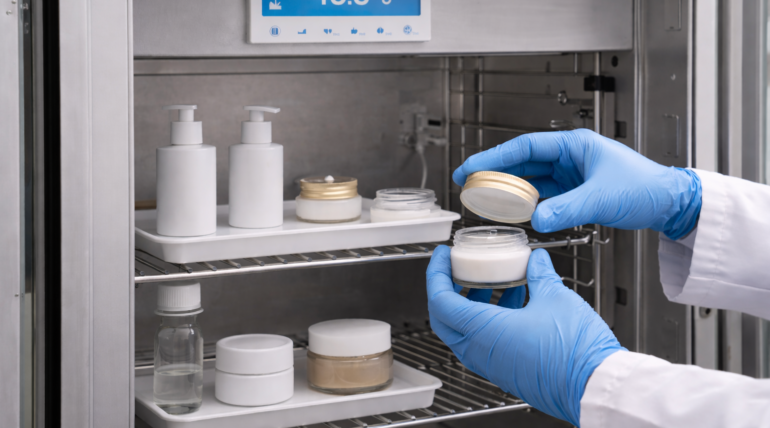
Stability testing for skincare products evaluates how formulations perform over time under different environmental conditions. These studies help determine whether a product maintains its appearance, texture, chemical composition, and safety throughout its intended shelf life.
Because skincare formulations often contain sensitive ingredients such as emulsifiers, botanical extracts, preservatives, and active compounds, stability testing plays a critical role in ensuring that products remain safe and effective from manufacturing through consumer use.
Why Stability Testing Is Important for Skincare
Skincare products may undergo significant changes during storage, transportation, and use. Exposure to heat, light, and air can affect the stability of cosmetic formulations.
Therefore, manufacturers perform stability studies to confirm that products maintain:
- physical appearance
- color and odor
- pH balance
- viscosity and texture
- preservative effectiveness
These evaluations help brands determine appropriate shelf life and storage conditions before launching a product.
The U.S. Food and Drug Administration recommends that cosmetic manufacturers ensure product safety through appropriate testing and stability evaluation.
https://www.fda.gov/cosmetics
Common Stability Testing Conditions
Laboratories typically evaluate skincare products under both accelerated and real-time conditions.
Accelerated Stability Testing
Accelerated studies expose products to elevated temperatures to simulate long-term storage.
Typical conditions include:
| Temperature | Purpose |
|---|---|
| 25 °C | Ambient storage |
| 40 °C | Accelerated aging |
| 45 °C | Stress conditions |
| 5 °C | Low-temperature stability |
Because higher temperatures accelerate chemical reactions, these conditions help predict how formulations may change over time.
Real-Time Stability Testing
Real-time stability studies evaluate products at normal storage conditions over an extended period.
These studies provide the most accurate indication of actual shelf life, although they require longer observation periods.
Key Parameters Evaluated During Stability Testing
Stability testing examines several indicators of formulation performance.
Physical Stability
Analysts evaluate visual changes such as:
- phase separation
- sediment formation
- color changes
- crystallization
These changes may indicate formulation incompatibility.
Chemical Stability
Some skincare ingredients degrade over time. Laboratories may analyze active ingredient concentrations or monitor pH drift during stability studies.
Chemical analysis ensures that the product maintains its intended performance.
Microbiological Stability
Preservatives must protect skincare products from microbial contamination during storage and use.
Microbiological evaluation may include preservative efficacy testing or microbial limit testing to confirm product safety.
Standards such as ISO 11930 outline methods for evaluating preservative systems in cosmetics.
https://www.iso.org
Packaging Compatibility Testing
Packaging materials can influence product stability. Certain plastics may absorb fragrance components or interact with active ingredients.
Therefore, laboratories often evaluate skincare products in their final packaging configuration during stability studies.
This helps ensure the product remains stable throughout its commercial life cycle.
Typical Duration of Cosmetic Stability Studies
The duration of stability testing depends on the product type and intended shelf life.
Common study timelines include:
- 3 months accelerated testing
- 6–12 months real-time testing
- additional monitoring for long-term studies
Results from accelerated conditions often help estimate expected shelf life before long-term data becomes available.
Stability Testing at Pentyl Labs
Pentyl Labs performs stability studies for skincare formulations to evaluate product performance under controlled environmental conditions.
Testing may include:
- accelerated temperature studies
- physical and visual evaluation
- pH monitoring
- formulation performance assessment
These studies help product developers confirm shelf life and identify potential formulation issues before commercialization.
For stability testing inquiries, contact:

