

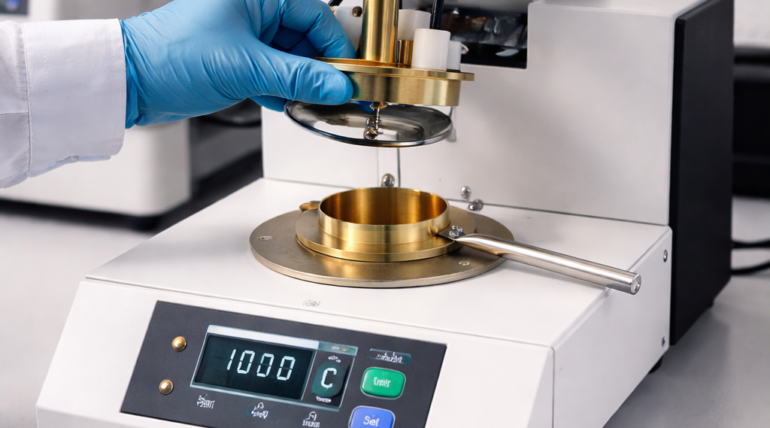
Flash point is the lowest temperature at which a liquid produces enough vapor to ignite when exposed to an ignition source such as a flame or spark.
Flash point is one of the most important measurements used to evaluate the flammability and fire risk of liquids, including solvents, fragrances, cosmetic formulations, cleaning products, adhesives, fuels, and many other chemical mixtures.
Because vapor ignition is the primary cause of many industrial and transportation fires, flash point testing plays an essential role in product safety, transportation classification, and regulatory compliance.
Manufacturers rely on flash point data to determine how liquids should be handled, labeled, stored, and transported safely.
Why Flash Point Testing Is Important
Understanding the flash point of a liquid helps determine how easily it can ignite during storage, transportation, or use.
Flash point testing is commonly required for:
- chemical safety evaluations
- Safety Data Sheets (SDS)
- hazard classification
- transportation regulations
- product safety assessments
Liquids with lower flash points release flammable vapors more easily, meaning they may present a greater fire risk.
For example:
| Material | Approximate Flash Point |
|---|---|
| Gasoline | −43 °C |
| Ethanol | 13 °C |
| Toluene | 4 °C |
| Water | Not flammable |
These differences highlight why flash point testing is critical for proper hazard classification and safe product handling.
Flash point values are often used in regulatory frameworks such as OSHA flammable liquid standards to determine hazard categories.
https://www.osha.gov/laws-regs/regulations/standardnumber/1910/1910.106
How Flash Point Is Measured
Flash point is determined using controlled laboratory testing where a liquid sample is gradually heated while a small ignition source is periodically introduced above the surface of the sample.
When the vapor concentration becomes sufficient to ignite momentarily, the temperature at that moment is recorded as the flash point.
Because testing conditions must be carefully controlled, flash point measurements are performed using standardized laboratory methods to ensure accurate and reproducible results.
These methods are published by organizations such as ASTM International, which develops widely used testing standards for material properties.
Common Flash Point Test Methods
Several standardized test methods are used to determine flash point depending on the material type, viscosity, and regulatory requirements.
ASTM D93 — Pensky-Martens Closed Cup
ASTM D93 is one of the most widely used flash point test methods for liquids such as:
- cosmetic formulations
- fragrances and perfumes
- cleaning products
- solvents
- adhesives
- fuels and petroleum mixtures
This method uses a closed test cup, which helps contain vapors during heating and often produces more conservative flash point values.
ASTM D93 is widely referenced for flammable liquid classification and regulatory testing.
ASTM D56 — Tag Closed Cup
ASTM D56 is typically used for low-viscosity liquids with relatively low flash points, such as certain solvents and fuels.
ASTM D92 — Cleveland Open Cup
ASTM D92 is an open cup method commonly used for petroleum products and materials with higher flash points.
This method can also determine fire point, which is the temperature at which sustained combustion occurs.
Flash Point vs Fire Point
Flash point and fire point are related but different measurements.
| Property | Meaning |
|---|---|
| Flash Point | Temperature where vapors ignite momentarily |
| Fire Point | Temperature where combustion continues for at least five seconds |
Fire point is always higher than flash point because additional vapor concentration is required to sustain burning.
Closed Cup vs Open Cup Flash Point Testing
Flash point tests are generally divided into two categories.
Closed Cup Tests
Closed cup tests contain vapors inside the apparatus during heating.
Characteristics include:
- vapors are confined within the instrument
- typically produce lower flash point values
- commonly used for regulatory classification
Example: ASTM D93 Pensky-Martens Closed Cup
Open Cup Tests
Open cup tests expose vapors to the surrounding environment.
Characteristics include:
- vapors are not contained
- often produce higher flash point values
- used for certain petroleum applications
Example: ASTM D92 Cleveland Open Cup
Flash Point Testing for Cosmetics and Cleaning Products
Flash point testing is especially important for consumer product formulations that contain volatile solvents or alcohols.
Products commonly requiring flash point evaluation include:
- perfumes and fragrances
- alcohol-based cosmetics
- hand sanitizers
- cleaning sprays and disinfectants
- adhesives and coatings
- solvent-based personal care products
For example, hand sanitizers and fragrance formulations often contain high concentrations of ethanol or isopropanol, which significantly lowers flash point values.
Understanding the flash point of these products helps manufacturers determine:
- transportation classifications
- storage requirements
- labeling obligations
- product safety documentation
Industries That Use Flash Point Testing
Flash point testing is used across many industries, including:
- cosmetics and personal care products
- fragrance manufacturing
- chemical manufacturing
- adhesives and coatings
- petroleum and fuels
- cleaning products and solvents
Many formulations containing volatile solvents require flash point testing to determine flammability classification and safe handling conditions.
ASTM D93 Flash Point Testing at Pentyl Labs
Pentyl Labs provides ASTM D93 flash point testing using the Pensky-Martens Closed Cup method for a wide range of liquid products.
Testing supports:
- Safety Data Sheet development
- product hazard classification
- transportation documentation
- regulatory compliance
- product safety evaluations
Samples are analyzed under controlled laboratory conditions and results are reported in a formal analytical report.
If you require flash point testing for your formulation, Pentyl Labs can assist with sample evaluation and testing coordination.
Related Flash Point Resources
You may also find these resources helpful:
Flammability Testing — Pentyl Labs
Flash Point Test Methods: ASTM D93 vs D92 vs D56 vs D3828
Closed Cup vs Open Cup Flash Point Testing
Pentyl Labs provides ASTM D93 flash point testing services for cosmetics, fragrances, cleaning products, solvents, adhesives, and chemical formulations.
To request a quote, contact [email protected].


2 Comments
Comments are closed.