

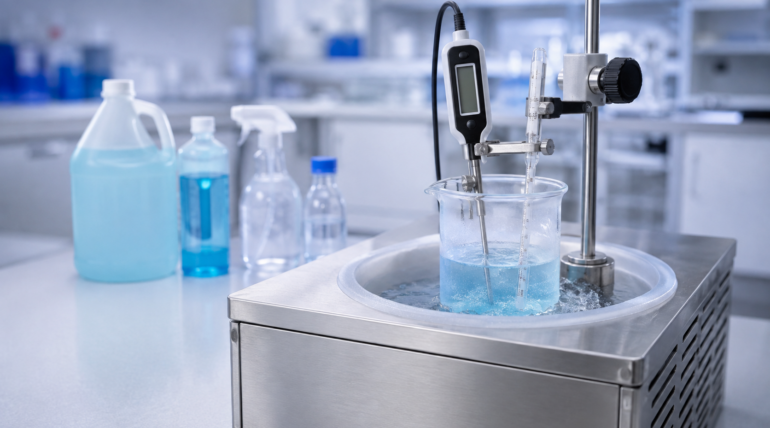
Pentyl Labs provides ASTM D1177 freeze point testing for aqueous engine coolants. We also offer specialized freeze point evaluations for windshield washer fluids, cleaners, cosmetics, and other aqueous liquid products.
ASTM D1177 Freeze Point Testing
Pentyl Labs provides ASTM D1177 testing for aqueous engine coolants. We also perform specialized freeze point evaluations for windshield washer fluids, cleaners, cosmetics, and other aqueous liquid products.
Companies use this testing to evaluate cold temperature performance, confirm specifications, compare formulations, and investigate crystallization concerns. In addition, the results can support storage and transportation decisions.
What Is ASTM D1177?
ASTM D1177 is a laboratory method for determining the freezing point of aqueous engine coolant solutions. You can review the official method scope from ASTM International.
During ASTM D1177 testing, our laboratory cools the sample under controlled conditions. Meanwhile, an analyst monitors the temperature and observes the sample for crystal formation. These observations help determine the freezing point.
For engine coolants, the result indicates the level of freeze protection provided by the formulation. Furthermore, when the glycol type is known, the result may help estimate the approximate glycol or glycerin concentration.
What Products Can Pentyl Labs Test?
Pentyl Labs performs ASTM D1177 testing for aqueous engine coolants. However, we can also conduct modified freeze point evaluations for other suitable liquids.
Products may include:
• Engine coolants
• Antifreeze products
• Windshield washer fluids
• Household cleaners
• Industrial cleaners and degreasers
• Liquid soaps and detergents
• Cosmetic and personal care products
• Water based sprays
• Glycol solutions
• Maintenance fluids
• Research and development formulations
• Other aqueous liquid products
The official ASTM D1177 scope applies to aqueous engine coolants. Therefore, Pentyl Labs uses careful reporting language when evaluating a product outside that scope. For example, we may describe the test as a modified procedure based on ASTM D1177 principles.
Why Is Freeze Point Testing Important?
Liquid products may encounter freezing temperatures during manufacturing, storage, transportation, delivery, or consumer use. As a result, manufacturers need to understand how their products perform under cold conditions.
Cold exposure may cause:
• Crystal formation
• Complete or partial freezing
• Thickening or loss of flow
• Phase separation
• Cloudiness or precipitation
• Changes in appearance
• Packaging deformation
• Leakage or container failure
• Failure to recover after thawing
Therefore, freeze point testing can identify the temperature at which these changes begin. The results may also help determine whether a product is suitable for its intended storage and transportation conditions.
Windshield Washer Fluid Freeze Point Testing
Freeze protection is an important performance characteristic for windshield washer fluid. If the liquid freezes or forms too many crystals, it may not flow properly through the vehicle reservoir, pump, tubing, or spray nozzles.
Manufacturers can use the results to verify cold temperature performance and evaluate product label claims. In addition, testing can help compare alcohol or glycol concentrations, establish specifications, and monitor production consistency.
Because windshield washer fluid is not an engine coolant, Pentyl Labs may use a modified procedure based on ASTM D1177. This approach provides useful freeze point data while accurately describing the scope of the evaluation.
Freeze Point Testing for Cleaners
Household and industrial cleaners often contain water, surfactants, solvents, salts, alcohols, or glycol ethers. Each ingredient can affect when the product begins to freeze or form crystals.
For example, testing may benefit all purpose cleaners, degreasers, glass cleaners, floor cleaners, detergent solutions, maintenance chemicals, and water based concentrates.
The resulting data can support product development and quality control. Moreover, manufacturers can use the information to establish storage recommendations, make seasonal shipping decisions, and compare formulations.
Freeze Point Testing for Cosmetics
Cosmetics and personal care products may experience freezing temperatures during shipping or storage. Consequently, cold exposure can affect their appearance, texture, viscosity, and physical stability.
Suitable products may include shampoos, conditioners, body washes, liquid soaps, facial cleansers, toners, water based serums, and cosmetic sprays.
Depending on the formulation, Pentyl Labs can document crystallization, freezing, thickening, phase separation, and other visible changes. However, freeze point testing does not replace a complete cosmetic stability study. Instead, it provides supporting information about how the product behaves at low temperatures.
How Does ASTM D1177 Testing Work?
First, the analyst places the sample in a suitable test vessel. Next, the laboratory cools the product under controlled conditions while monitoring its temperature.. At the same time, the analyst stirs the sample and watches for crystal formation.
Temperature behavior and visible crystallization determine the measured freeze point. Nevertheless, some complex formulations do not produce one sharply defined result. A product may gradually thicken, form slush, separate, or partially crystallize as the temperature decreases.
In those situations, the final report can describe the observed behavior. As a result, the client receives relevant information even when the product does not exhibit a distinct freezing point.
What Does the Test Report Include?
A Pentyl Labs report may include:
• Client and sample identification
• Product description
• Test method or modified procedure
• Measured freeze point
• Results in degrees Celsius and degrees Fahrenheit
• Relevant visual observations
• Method modifications or deviations
• Applicable test limitations
For products outside the formal scope, the report clearly identifies the modified procedure. Therefore, clients can understand exactly how the laboratory evaluated the sample.
Freeze Point Versus Pour Point
Freeze point and pour point measure different physical properties.
Freeze point testing determines when freezing or crystal formation occurs. In contrast, pour point testing determines the lowest temperature at which a liquid can still flow under specified conditions.
A product may become extremely thick or stop flowing before it freezes completely. Therefore, the correct method depends on the product, intended use, and required specification.
Frequently Asked Questions
What does ASTM D1177 measure?
Under controlled laboratory conditions, the method measures the freezing point of an aqueous engine coolant solution.
Can ASTM D1177 be used for windshield washer fluid?
The formal scope applies to aqueous engine coolants. However, Pentyl Labs can adapt the controlled cooling and crystallization principles for windshield washer fluid. In that case, the report identifies the test as a modified procedure.
Can cleaners and cosmetics be tested for freezing point?
Yes. Many aqueous cleaners, cosmetics, and personal care products can undergo freeze point evaluation. Depending on the formulation, the laboratory may need to modify the procedure.
Is freeze point testing the same as freeze and thaw stability testing?
No. Freeze point testing determines when freezing or crystallization occurs. By comparison, freeze and thaw stability testing repeatedly moves a product between cold and warm conditions. This process evaluates whether the formulation changes or recovers after temperature cycling.
Is freeze point the same as pour point?
No. Freeze point relates to freezing or crystal formation. In contrast, pour point relates to the ability of a liquid to flow.
How much sample is required?
The required amount depends on the product and its expected freezing range. Therefore, clients should contact Pentyl Labs before shipping samples.
How long does testing take?
Turnaround time depends on the sample type, expected freezing temperature, and requested observations. Pentyl Labs confirms the estimated schedule before testing begins.
Request ASTM D1177 Freeze Point Testing
Pentyl Labs provides ASTM D1177 testing for aqueous engine coolants. In addition, we offer specialized freeze point evaluations for windshield washer fluids, cleaners, cosmetics, and other aqueous liquids.
Contact Pentyl Labs with your product description, expected freezing range, and testing requirements to get started.

