
Introduction
Selling cosmetics on Amazon requires more than a strong product and branding — it requires proof that your product is safe, stable, and compliant with U.S. regulations.
Amazon increasingly requests documentation from sellers to verify product safety and labeling. If you’re unprepared, this can result in listing removals, delayed launches, or account risk.
This guide outlines what Amazon typically expects — and how to prepare before issues arise.
What Does Amazon Require for Cosmetic Products?
Amazon does not directly regulate cosmetics, but it enforces compliance with U.S. regulatory standards, primarily under the
U.S. Food and Drug Administration.
In practice, sellers may be required to provide:
- Full ingredient list (INCI format)
- Product labeling (including images of packaging)
- Safety or compliance documentation
- Test reports supporting product safety and stability
When Does Amazon Request Compliance Documentation?
Requests are typically triggered when:
- A new product is listed in a regulated category
- Product claims raise safety concerns (e.g., “hypoallergenic,” “non-irritating,” “dermatologist tested”)
- Certain ingredients or formulations are flagged
- Customer complaints or adverse events are reported
Once requested, documentation must be submitted quickly to avoid listing disruption.
What Testing Might Be Required?
Amazon does not publish a fixed testing checklist. However, based on real-world cases, the following categories are commonly requested:
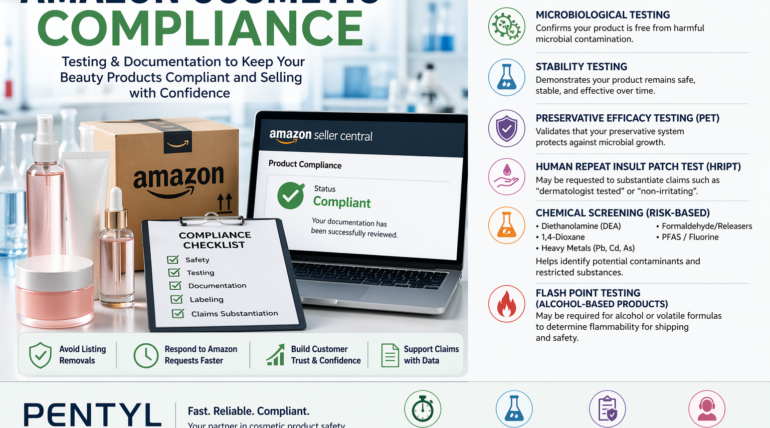
Microbiological Testing
Used to confirm the product is free from harmful microbial contamination.
Typical tests include:
- Total Plate Count (TPC)
- Yeast and Mold
- Pathogen screening (e.g., Staphylococcus aureus, Pseudomonas aeruginosa)
Stability Testing
Demonstrates that the product remains consistent and safe over time.
Common parameters:
- pH
- Color
- Odor
- Appearance
Accelerated stability testing (e.g., 40°C) is often used to simulate shelf-life.
🧬 Preservative Efficacy Testing (PET)
Ensures the preservative system effectively prevents microbial growth.
Often aligned with:
ISO 11930
Particularly important for water-based formulations.
Human Repeat Insult Patch Test (HRIPT)
May be requested to support product safety and marketing claims such as:
- “Dermatologist tested”
- “Non-irritating”
- “Suitable for sensitive skin”
Reference:
Human Repeat Insult Patch Test
HRIPT evaluates irritation and sensitization potential through controlled human testing.
While not always mandatory, it provides strong claim substantiation and can help satisfy Amazon compliance reviews.
Chemical Screening (Risk-Based)
Additional testing may be required depending on ingredients, claims, or regulatory concerns.
Examples include:
- Diethanolamine (DEA)
- 1,4-Dioxane
- Heavy metals (lead, cadmium, arsenic)
- Formaldehyde or formaldehyde-releasing preservatives
- PFAS / fluorine (increasingly requested for packaging and formulations)
1,4-dioxane is particularly relevant for products containing ethoxylated surfactants (e.g., PEGs, SLES) and may be flagged during compliance reviews.
Flammability / Flash Point Testing (Alcohol-Based Products)
Products containing alcohol or volatile components may require flash point testing to determine flammability classification for shipping and safety.
Reference:
Flash Point
Common product types:
- Fragrance sprays and body mists
- Hand sanitizers
- Hair sprays and styling products
- Essential oil blends
- Alcohol-based skincare
Testing is commonly performed using:
- ASTM D93 for viscous or semi-solid products
This is especially relevant when Amazon or shipping carriers require hazard classification documentation.
Do You Always Need Testing?
Not always — but in practice:
- If Amazon requests documentation, you must provide it
- If you cannot provide it, your listing may be removed
Many brands now perform baseline testing proactively to avoid disruptions.
Labeling Requirements for Amazon Cosmetics
Products must comply with U.S. labeling regulations, including:
- Product identity
- Net quantity of contents
- Ingredient declaration (INCI format)
- Manufacturer or distributor information
Reference:
21 CFR 701
Common Mistakes Sellers Make
- Assuming “natural” products don’t require testing
- Relying on raw material COAs instead of finished product testing
- Skipping preservative validation
- Using non-compliant or incomplete labels
- Overlooking flammability classification for alcohol-based formulas
- Making claims without proper substantiation (e.g., no HRIPT)
- Ignoring potential contaminants like 1,4-dioxane
- Waiting until Amazon flags the product
How to Prepare Before Amazon Requests Documentation
To reduce risk and avoid delays:
- Conduct microbiological testing
- Run accelerated stability studies
- Validate your preservative system
- Perform targeted chemical screening (including contaminants like 1,4-dioxane where applicable)
- Evaluate flammability for alcohol-based products
- Substantiate claims with appropriate testing (e.g., HRIPT)
- Ensure labeling compliance
Preparation allows for fast response and uninterrupted sales.
How Pentyl Labs Supports Amazon Sellers
Pentyl Labs provides practical, fast-turnaround testing solutions tailored to Amazon compliance:
- Microbiological testing (USP <61>/<62>)
- Stability testing programs (1–6 months)
- Preservative efficacy testing
- Human Repeat Insult Patch Testing (HRIPT)
- Chemical screening (DEA, 1,4-dioxane, PFAS, metals)
- Flash point testing for alcohol-based formulations
- Labeling and compliance guidance
Designed to help sellers meet requirements quickly and confidently.
Conclusion
Amazon cosmetic compliance is not about a single requirement — it’s about demonstrating that your product is safe, stable, and properly labeled.
Brands that prepare in advance can respond quickly and avoid costly disruptions, while those that wait risk losing listings and momentum.
Need Help With Amazon Compliance?
Whether you’re launching a product or responding to an Amazon request, Pentyl Labs can help you generate the documentation you need — quickly and clearly.
Contact: [email protected]

