
Short Answer
A CPSR (Cosmetic Product Safety Report) is a mandatory safety assessment required for cosmetic products sold in the European Union (EU) and United Kingdom (UK). It ensures that a product is safe for human use under normal or reasonably foreseeable conditions.
What Does CPSR Stand For?
CPSR = Cosmetic Product Safety Report
It is a formal document prepared by a qualified safety assessor (typically a toxicologist or similarly credentialed expert) in accordance with:
- EU Cosmetic Regulation (EC) No. 1223/2009
- UK Cosmetic Regulations (post-Brexit equivalent)
Without a CPSR, a cosmetic product cannot legally be placed on the EU or UK market.
What Is Included in a CPSR?
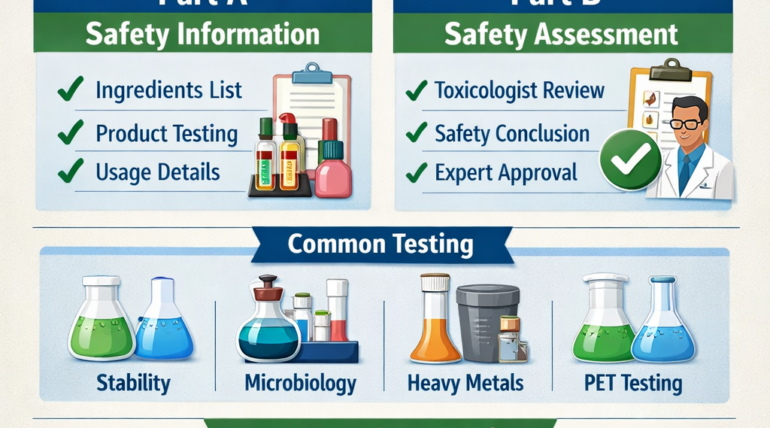
A CPSR is divided into two main parts:
Part A – Cosmetic Product Safety Information
This section gathers all technical data about the product, including:
- Quantitative & qualitative composition (full ingredient list with %)
- Physical and chemical characteristics
- Microbiological quality
- Impurities and packaging compatibility
- Normal and reasonably foreseeable use
- Exposure assessment
- Toxicological profile of ingredients
- Undesirable effects (if known)
Part B – Cosmetic Product Safety Assessment
This is the expert conclusion, including:
- Safety assessor’s evaluation
- Margin of Safety (MoS) calculations
- Final safety statement (e.g., “safe under intended conditions of use”)
- Assessor credentials and signature
What Testing Is Needed for a CPSR?
The required testing depends on the formulation, but most CPSRs rely on a combination of:
Common Supporting Data:
- Stability Testing (e.g., 40°C accelerated studies)
- Microbiological Testing
- Preservative Effectiveness Test (PET / ISO 11930)
- Heavy Metals Testing (USP <232>/<233>)
- Packaging Compatibility Testing
When Testing May Not Be Required:
For certain products—like anhydrous or low-risk formulations—some tests (e.g., PET or micro) may be reduced or waived if scientifically justified by the safety assessor.
Do You Need a CPSR?
You need a CPSR if you are:
- Selling cosmetics in the EU or UK
- A brand owner, importer, or responsible person
- Launching products like:
- Skincare (creams, serums, lotions)
- Haircare products
- Makeup
- Personal care products (soaps, deodorants, etc.)
CPSR vs. U.S. Requirements
In the United States, a CPSR is not legally required. However:
- Safety substantiation is still required under FDA regulations
- A CPSR (or similar safety assessment) can strengthen:
- Retail acceptance (e.g., Sephora, Amazon)
- Liability protection
- Regulatory readiness for global expansion
How Long Does a CPSR Take?
Typical turnaround times:
- 2–4 weeks if all required data is available
- Longer if additional testing is needed
How Much Does a CPSR Cost?
- $450 per product
How Pentyl Labs Can Help
At Pentyl Labs, we support CPSR preparation by:
- Coordinating required testing (stability, metals, PET, etc.)
- Reviewing your existing data (supplier COAs, prior testing)
- Working with qualified safety assessors
- Providing a streamlined, single point of contact
If you’re missing data, we can either:
- Perform the required testing
- Work with available data (with appropriate report notations)
Key Takeaways
- A CPSR is mandatory for EU/UK cosmetic products
- It includes technical data + expert safety assessment
- Testing requirements vary based on formulation
- Even in the U.S., it’s a valuable risk and compliance tool
Need a CPSR?
Contact us at [email protected] to get started or request a quote.


