
Shop
Description
Time Kill Testing (ASTM E2315)
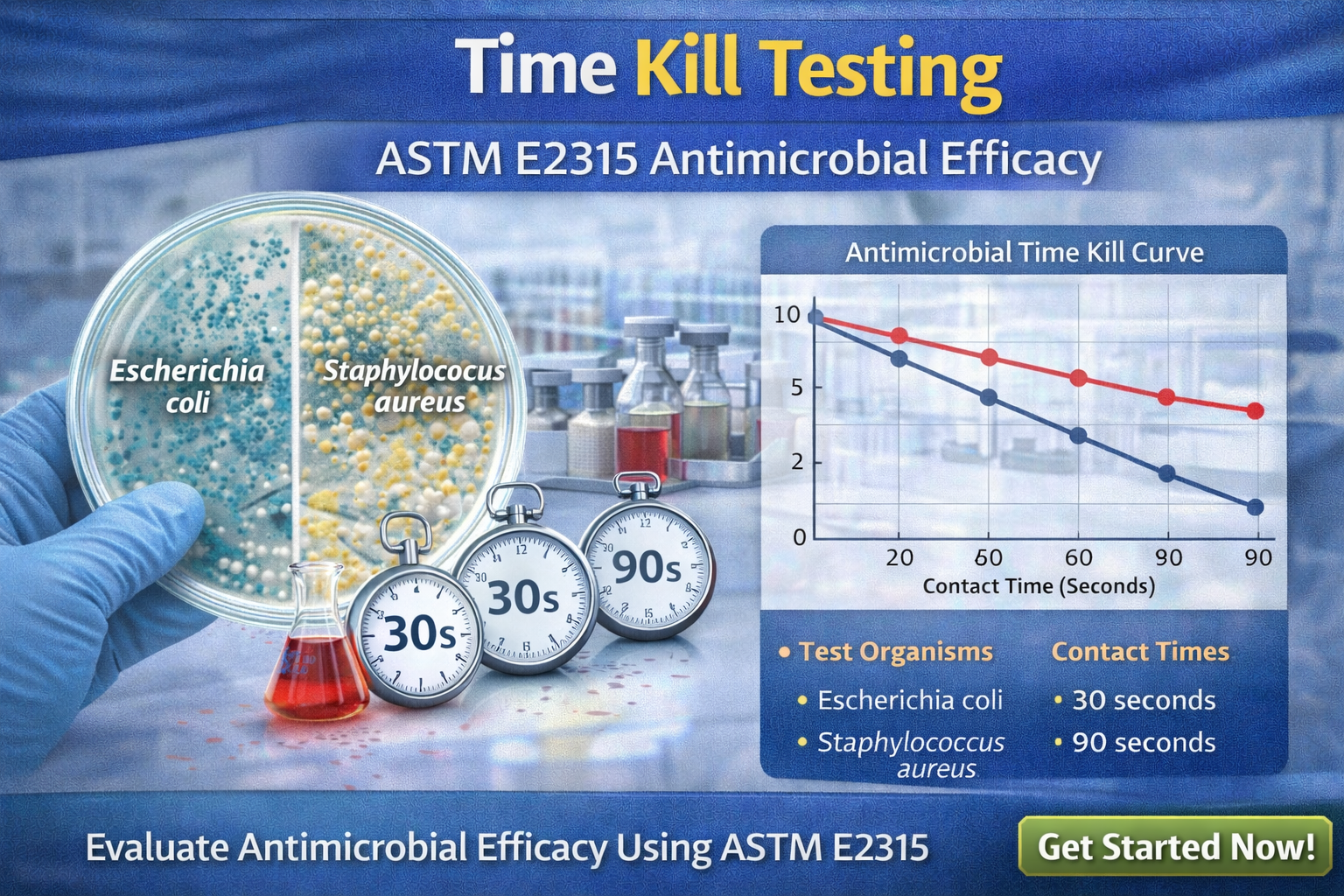
Our Time Kill Testing service evaluates the antimicrobial effectiveness of products by measuring the reduction of microorganisms over specific contact times. We perform this testing in accordance with ASTM E2315, a widely recognized method for assessing the time-dependent killing activity of antimicrobial agents.
Time kill testing provides quantitative data that demonstrates how quickly and effectively a product reduces microbial populations. Therefore, it is commonly used to support efficacy claims, product development decisions, and regulatory or customer requirements.
Time Kill Testing (ASTM E2315)
Our Time Kill Testing service evaluates antimicrobial effectiveness by measuring the reduction of microorganisms over defined contact times. We perform this testing in accordance with ASTM E2315, a recognized laboratory method for assessing time-dependent antimicrobial activity.
Because antimicrobial performance often depends on exposure time, time-dependent antimicrobial efficacy testing provides valuable insight beyond pass/fail screening. Therefore, manufacturers use this method to understand both the speed and extent of microbial reduction.
What Is ASTM E2315 Time-Kill Testing?
ASTM E2315 describes a quantitative laboratory procedure that measures changes in viable microorganisms after exposure to a test substance for specific durations. As a result, the method allows evaluation of how quickly an antimicrobial formulation acts.
The standard is published by ASTM International and is widely used across cosmetic, pharmaceutical, and consumer product industries.
Test Organisms and Contact Times
Our standard antimicrobial time-kill study includes:
-
Escherichia coli
-
Staphylococcus aureus
Testing is performed at defined exposure periods, including:
-
30 seconds
-
90 seconds
Additional organisms or time points may be evaluated upon request, depending on project goals.
What the Study Includes
This service includes:
-
Preparation of test and control samples
-
Inoculation with defined microbial populations
-
Controlled exposure at specified time intervals
-
Neutralization and microbial recovery
-
Enumeration of surviving organisms
-
Calculation of log-reduction values
Moreover, analysts review results for accuracy and consistency before final reporting.
Common Applications
This type of testing supports:
-
Antimicrobial and disinfectant products
-
Preservative systems and formulation screening
-
Hand sanitizers and topical products
-
Product development and efficacy benchmarking
Because results show microbial reduction over time, the data supports informed formulation and marketing decisions.
Why Choose Pentyl Labs?
Pentyl Labs delivers clear and defensible Time Kill Testing results with practical turnaround times. In addition, we support broader microbiology programs such as preservative efficacy and microbial limits testing. As a result, data integrates smoothly into development, quality, and compliance workflows.
📩 Contact [email protected] to request testing.


