
Shop
Description
Asbestos Analysis by TEM (Transmission Electron Microscopy)
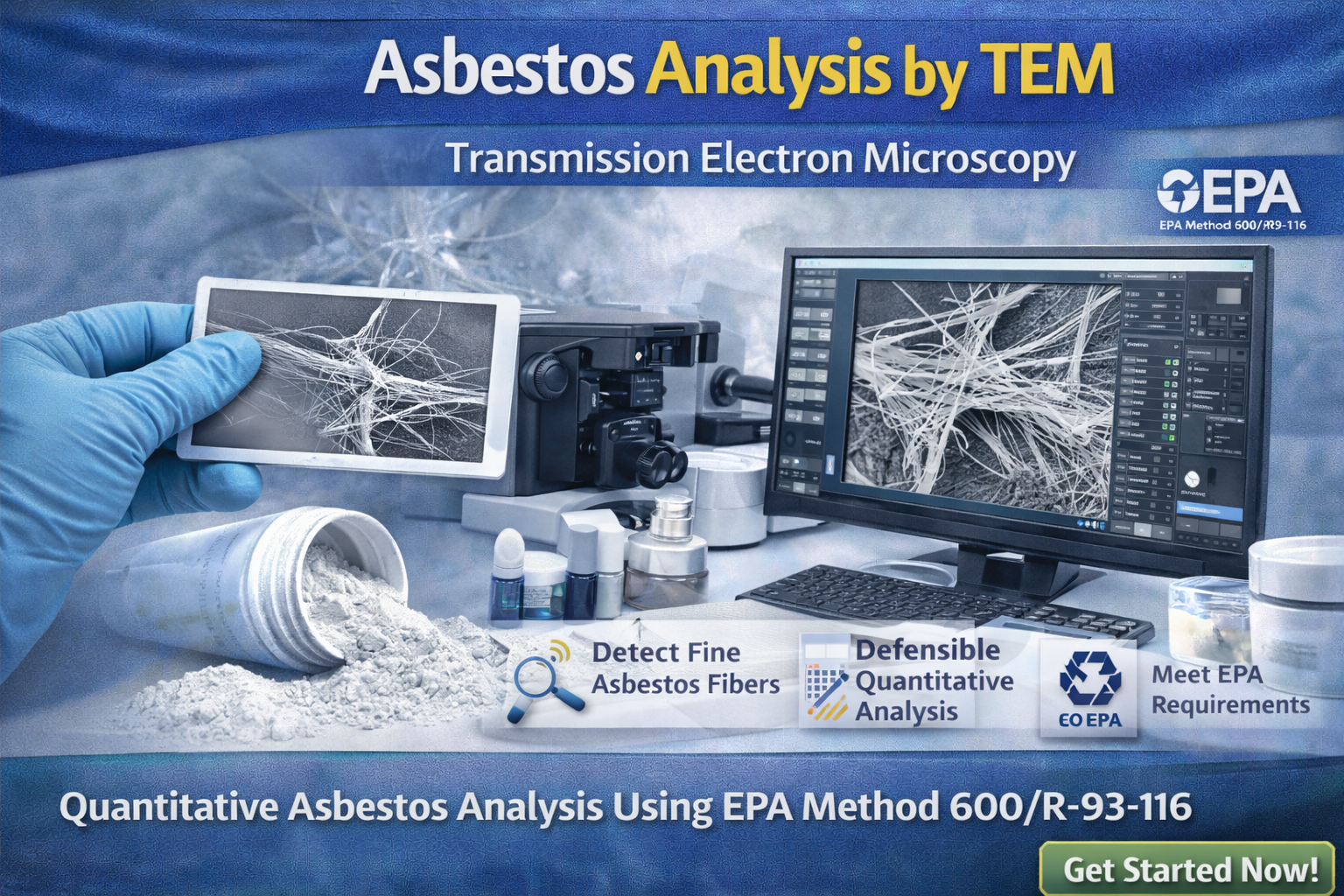
Our Asbestos Analysis by TEM service provides sensitive and reliable identification of asbestos fibers using transmission electron microscopy in accordance with EPA Method 600/R-93-116. This testing helps manufacturers and product owners evaluate asbestos content while meeting regulatory and safety expectations.
Because asbestos fibers can exist at very low levels, TEM offers the resolution needed to detect and confirm fiber presence. Therefore, this method is often selected when screening methods do not provide clear answers or when regulatory scrutiny is high. In particular, cosmetic talc, raw ingredients, and bulk materials often require this level of analysis.
What Is TEM Asbestos Testing?
Transmission electron microscopy allows analysts to directly view fibers at very high magnification. In addition, the method confirms fiber identity using both elemental composition and crystal structure. As a result, TEM can detect asbestos fibers that other microscopy techniques may miss.
The testing follows EPA Method 600/R-93-116, which defines procedures for bulk quantitative asbestos analysis. This method is published by the U.S. Environmental Protection Agency and is widely accepted for regulatory, legal, and quality investigations.
What the Analysis Includes
This service includes:
-
Sample preparation and homogenization
-
High-resolution TEM imaging
-
Energy-dispersive X-ray spectroscopy (EDS)
-
Selected area electron diffraction (SAED)
-
Identification of regulated asbestos fiber types
-
Quantitative reporting aligned with EPA guidance
Moreover, the analysis evaluates all regulated asbestos types, including chrysotile, amosite, crocidolite, tremolite, anthophyllite, and actinolite.
Common Applications
TEM asbestos testing is commonly used for:
-
Cosmetic talc and talc-containing products
-
Raw cosmetic and pharmaceutical ingredients
-
Powders, pigments, and fillers
-
Industrial bulk materials
Because of its high sensitivity, TEM is often used when confirmatory analysis is required or when PLM results are inconclusive.
Why Choose Pentyl Labs?
Pentyl Labs provides clear and defensible asbestos analysis by TEM with practical turnaround times. In addition, we support broader product safety and compliance programs. Therefore, clients receive data that integrates smoothly into regulatory submissions and internal quality systems.
📩 Contact [email protected] to request testing.
U.S. Environmental Protection Agency – EPA Method 600/R-93-116


