
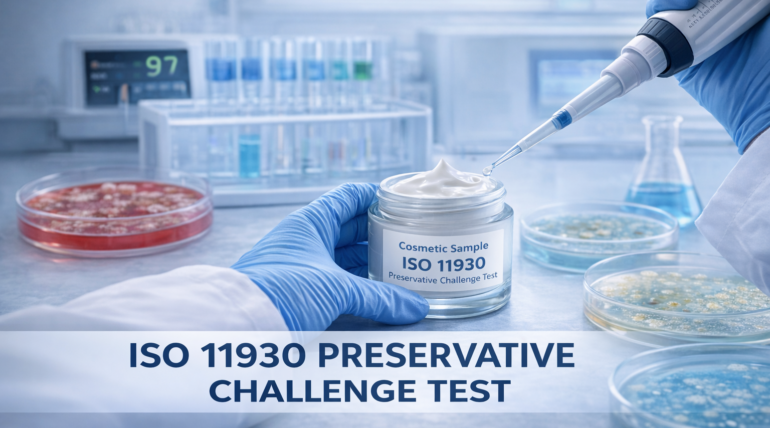
The ISO 11930 challenge test evaluates whether preservatives in cosmetic and personal care products effectively control microbial contamination. Manufacturers perform this test during product development to ensure formulations remain safe and stable throughout their shelf life.
One of the most widely used standards for this evaluation is ISO 11930, an international test method used to assess the antimicrobial protection of cosmetic formulations.
The ISO 11930 preservative challenge test intentionally introduces microorganisms into a product and measures how effectively the preservative system eliminates or controls microbial growth over time.
This testing helps manufacturers ensure products remain safe, stable, and compliant with global cosmetic regulations.
What Is the ISO 11930 Challenge Test?
ISO 11930 is an internationally recognized standard that evaluates the preservative effectiveness of cosmetic products.
During the test, laboratories deliberately inoculate a product with specific microorganisms that are known to contaminate cosmetic formulations.
These microorganisms typically include:
- Staphylococcus aureus
- Pseudomonas aeruginosa
- Escherichia coli
- Candida albicans
- Aspergillus brasiliensis
After inoculation, analysts monitor microbial reduction over a defined time period to determine whether the preservative system effectively controls contamination.
The standard is published by the International Organization for Standardization (ISO).
https://www.iso.org
Why Preservative Challenge Testing Is Important
Cosmetic products often contain water, botanical ingredients, and nutrients that can support microbial growth. Without adequate preservation, microorganisms may multiply and compromise product safety.
Preservative challenge testing helps manufacturers:
- verify preservative system effectiveness
- identify potential contamination risks
- support cosmetic safety assessments
- demonstrate regulatory compliance
- ensure product shelf life and stability
As a result, ISO 11930 testing is frequently required during cosmetic product development and safety evaluations.
How the ISO 11930 Test Works
The preservative challenge test follows a controlled laboratory process designed to simulate microbial contamination.
The general procedure includes:
- Product Inoculation
The cosmetic formulation is inoculated with a defined concentration of test microorganisms. - Controlled Incubation
The product is stored under controlled conditions to allow microbial interaction with the preservative system. - Microbial Enumeration
Analysts measure microbial counts at specific time intervals, typically including Day 7, Day 14, and Day 28. - Performance Evaluation
Results are compared against ISO 11930 acceptance criteria to determine whether the preservative system is effective.
A successful preservative system will demonstrate significant microbial reduction over time.
ISO 11930 Acceptance Criteria
ISO 11930 includes specific performance criteria that determine whether a preservative system passes or fails.
These criteria evaluate the log reduction of microorganisms over defined time periods.
The standard typically defines two evaluation levels:
Criterion A
Indicates strong preservative performance and rapid microbial reduction.
Criterion B
Indicates acceptable preservative performance when Criterion A cannot be achieved.
Products must meet at least Criterion B requirements to demonstrate adequate preservation.
Products That Require ISO 11930 Testing
Preservative challenge testing is commonly performed for:
- lotions and creams
- facial serums
- shampoos and conditioners
- liquid soaps and body washes
- cosmetic emulsions
- cosmetic gels
- alcohol-reduced hand sanitizers
Products with water content or botanical ingredients are especially susceptible to microbial contamination and therefore require preservative testing.
ISO 11930 vs USP <51> Preservative Effectiveness Testing
Another commonly used preservative test is USP <51> Antimicrobial Effectiveness Testing.
Both methods evaluate preservative performance, but they differ in scope.
| Method | Primary Application |
|---|---|
| ISO 11930 | Cosmetic products |
| USP <51> | Pharmaceutical and some personal care products |
Cosmetic manufacturers typically rely on ISO 11930 because it is specifically designed for cosmetic formulations.
ISO 11930 Testing at Pentyl Labs
Pentyl Labs provides ISO 11930 preservative challenge testing for cosmetic and personal care products.
Testing helps manufacturers evaluate whether their preservative systems effectively control microbial contamination throughout the product lifecycle.
Our testing services support:
- cosmetic product development
- safety assessments
- regulatory documentation
- preservative system optimization
Samples are analyzed under controlled laboratory conditions and results are reported in a formal analytical report.
If you require preservative challenge testing for your cosmetic formulation, Pentyl Labs can assist with sample evaluation and testing coordination.
Contact [email protected] to request a quote.
Related Microbiological Testing Services
You may also find these services helpful:
Microbiological Testing for Cosmetics
Total Aerobic Microbial Count (TAMC)
Total Yeast and Mold Count (TYMC)


