
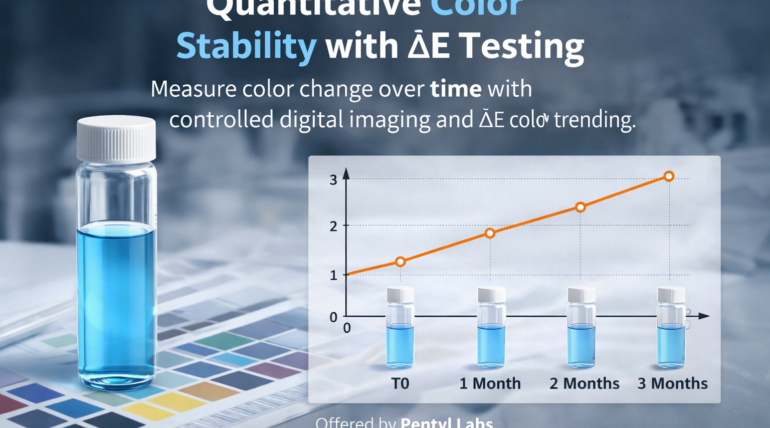
ΔE in stability testing refers to the measurable color difference between a product’s baseline appearance (T0) and subsequent timepoints during a stability study. Rather than relying only on visual observation, ΔE quantifies how much a product’s color has changed over time.
This is especially valuable for products susceptible to oxidation, fragrance discoloration, or ingredient degradation.
Why Color Change Matters in Stability Studies
During accelerated or real-time stability testing, products may experience:
- Yellowing or browning
- Darkening
- Fading
- Surface discoloration
- Oxidative shifts
Even subtle color changes can signal formulation instability or packaging interaction.
Traditional reporting often states:
“Slight discoloration observed.”
ΔE provides measurable confirmation.
Understanding ΔE Values
ΔE represents overall color difference in CIELAB color space.
General interpretation:
- ΔE < 1 → No visible difference
- ΔE 1–2 → Slight change
- ΔE 2–3 → Noticeable change
- ΔE > 3 → Obvious change
Tracking ΔE over time allows formulators to detect instability earlier in development.
For more information on our stability programs, see: 12-Week Accelerated Stability & Compatibility Testing
Color calculations are based on CIELAB colorimetry principles defined by the CIE: https://cie.co.at
When ΔE Trending Is Most Useful
ΔE monitoring is particularly valuable for:
- Naturally derived formulations
- Fragrance-containing systems
- Emulsions prone to oxidation
- Products with appearance-sensitive marketing claims
At Pentyl Labs, ΔE trending is performed under controlled imaging conditions to ensure repeatability between timepoints.
For customized programs, contact [email protected].


