
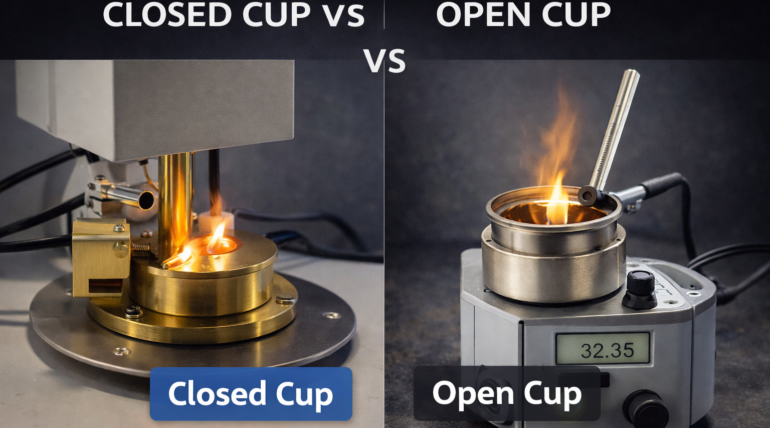
Closed Cup vs Open Cup Flash Point: What’s the Difference?
Understanding closed cup vs open cup flash point testing is essential when classifying flammable materials, preparing SDS documents, and ensuring transport compliance. Although both methods measure flash point, they simulate very different conditions. As a result, they often produce different temperatures.
Selecting the wrong method can lead to incorrect hazard classification.
What Is Flash Point?
Flash point is the lowest temperature at which a liquid produces enough vapor to ignite when exposed to an ignition source. Therefore, it plays a critical role in transportation safety, regulatory compliance, and product labeling.
However, the way a laboratory measures flash point directly affects the reported value. That is where the difference between closed cup and open cup methods becomes important.
Closed Cup Flash Point Testing
In closed cup testing, the sample sits inside a sealed chamber. As the instrument heats the liquid, vapors accumulate above the surface. Because the vapors remain confined, the test environment closely simulates real storage and shipping conditions.
Common closed cup methods include:
- ASTM D93 (Pensky-Martens)
- ASTM D56 (Tag Closed Cup)
- ASTM D3828 (Setaflash Small Scale)
Most cosmetic, personal care, and consumer products require closed cup testing. In particular, ASTM D93 is widely accepted for emulsions, cleaning products, fragrance systems, and finished formulations.
Since vapors remain contained, closed cup methods typically produce lower and more conservative flash point values.
You can learn more about our closed cup testing here: ASTM D93 Flash Point Testing
Open Cup Flash Point Testing
By contrast, open cup testing exposes the sample to ambient air. As the liquid heats, vapors freely disperse into the surrounding environment. Consequently, vapor concentration above the liquid surface builds more slowly.
The primary open cup method is:
- ASTM D92 (Cleveland Open Cup)
Open cup testing is generally used for:
- Lubricants
- Waxes
- Asphalt materials
- High-temperature industrial products
Because vapors escape during heating, open cup methods usually report higher flash point values than closed cup methods.
Why Results Differ Between Methods
The difference between closed cup vs open cup flash point results comes down to vapor containment.
Closed cup:
- Confines vapors
- Builds concentration faster
- Produces lower flash point values
Open cup:
- Allows vapor escape
- Builds concentration more slowly
- Produces higher flash point values
For regulatory classification, most authorities prefer closed cup values when available.
ASTM International publishes both standards: https://www.astm.org
Which Method Should You Choose?
Ultimately, the correct method depends on:
- Product volatility
- Regulatory requirements
- Intended use
- Industry standards
For cosmetics, emulsions, and consumer goods, closed cup methods almost always apply. On the other hand, high-temperature industrial materials often require open cup testing.
If you are unsure which method fits your product, Pentyl Labs can provide guidance before testing begins.
Contact [email protected] to discuss your formulation.


2 Comments
Comments are closed.