
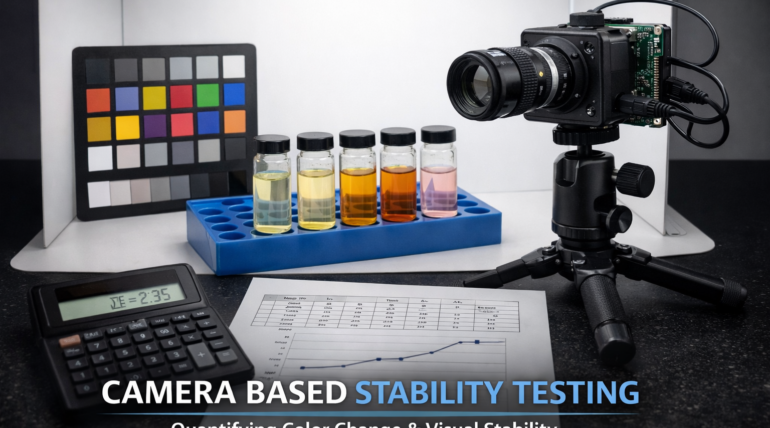
Camera Based Stability Testing at Pentyl Labs
Camera based stability testing enhances traditional visual stability studies by turning appearance changes into measurable, trendable data. Instead of relying only on subjective observation, Pentyl Labs performs controlled digital imaging to quantify color shift, separation, and visual degradation over time.
Stability studies remain essential for assessing shelf life, PAO, and overall product integrity. However, early and subtle visual changes often require more than observation alone.
How Camera Based Stability Testing Improves Stability Studies
Camera based stability testing allows us to evaluate products under:
- Controlled lighting conditions
- Fixed imaging geometry
- Standardized color reference targets
As a result, visual changes become measurable. Using relative CIELAB values (L*a*b*), we calculate ΔE*ab versus baseline (T0) to track color change throughout the stability program.
Unlike traditional “observed discoloration” notes, this approach provides quantifiable trend data.
Many of these visual stability assessments are integrated into our 12-Week Accelerated Stability & Compatibility Testing program.
Measuring ΔE in Camera Based Stability Testing
ΔE represents overall color difference between two measurements.
In practical interpretation:
- ΔE < 1 → No visible change
- ΔE 1–2 → Slight change
- ΔE 2–3 → Noticeable change
- ΔE > 3 → Obvious change
By trending ΔE during stability, Pentyl Labs can:
- Detect oxidation early
- Evaluate antioxidant performance
- Assess fragrance discoloration
- Compare packaging compatibility
- Monitor long-term visual integrity
Color space calculations are based on CIELAB principles defined by CIE colorimetry standards.
Additional Endpoints in Camera Based Stability Testing
Beyond color change, camera based stability testing supports evaluation of:
- Phase separation
- Sedimentation or creaming
- Turbidity and clarity shifts
- Foam persistence
- Surface texture changes
These observations complement physical parameters such as pH, weight loss, and odor, which are evaluated during stability programs.
Stability studies are often complemented by microbial integrity testing, which is detailed in our Microbiological Testing Services page.
Controlled and Repeatable Stability Evaluation
Pentyl Labs performs camera based stability testing under standardized imaging conditions to improve consistency between timepoints. Images are archived and analyzed using controlled reference targets to reduce variability.
Importantly, this method provides relative visual trend data. It does not replace formal color standards such as ASTM D1544 or ISO-certified spectrophotometric methods. Instead, it enhances R&D and shelf-life decision making by strengthening visual documentation.
When to Use Camera Based Stability Testing
This approach is particularly valuable for:
- Naturally derived formulations susceptible to oxidation
- Emulsions prone to discoloration
- Clear systems where haze or precipitation may occur
- Products with visual clarity or appearance claims
When combined with traditional stability testing parameters, camera based stability testing strengthens overall shelf-life assessment.
Contact Pentyl Labs
Pentyl Labs performs stability testing programs tailored to formulation type, packaging system, and regulatory requirements.
For customized programs, contact 📧 [email protected]


