
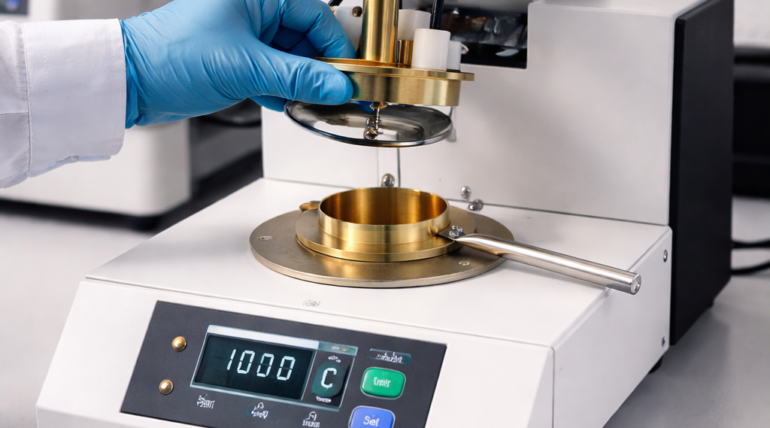
The ASTM D93 flash point test determines the temperature at which a liquid produces vapors that ignite under controlled conditions. Laboratories perform this test using the Pensky-Martens closed cup apparatus, which contains vapors during heating.
Manufacturers commonly request this method when they need reliable flammability data for:
- adhesives
- coatings
- solvents
- fuels
- chemical mixtures
Because the apparatus contains vapors, the method often provides more conservative ignition temperature values than open-cup procedures.
ASTM International publishes this standard to ensure consistent and reproducible results across laboratories.
(Outbound link: https://www.astm.org)
Why ASTM D93 Is Important
Companies rely on ASTM D93 results to classify liquids for:
- Safety Data Sheets (SDS)
- shipping and transport regulations
- workplace hazard communication
- product safety evaluations
For example, OSHA classifies flammable liquids partly based on flash point thresholds.
(Outbound link: https://www.osha.gov/flammable-liquids)
Therefore, an accurate result directly affects hazard labeling and storage requirements.
Additionally, insurers and safety professionals often require documented testing before approving large-scale storage.
How the Pensky-Martens Closed Cup Method Works
The ASTM D93 flash point test follows a controlled heating process.
First, the laboratory places a measured volume of liquid into the closed test cup.
Next, the instrument heats the sample at a specified rate.
Then, at defined temperature intervals, the operator introduces a small ignition source.
When vapors ignite momentarily, the instrument records that temperature as the flash point.
Because the system remains enclosed, vapor concentration builds consistently. As a result, the method provides dependable data for regulatory classification.
When ASTM D93 Is Required
You typically need the ASTM D93 flash point test when:
- A liquid has moderate to high viscosity
- The expected ignition temperature exceeds 23 °C
- Regulatory agencies require closed-cup results
- You are preparing or updating an SDS
In contrast, low-viscosity solvents with very low flash points may use ASTM D56 instead.
If you are unsure which method applies, reviewing the product’s composition and intended use will help determine the correct standard.
ASTM D93 vs Other Flash Point Methods
Several standards measure ignition temperature. However, they differ in apparatus design and application.
| Method | Apparatus | Typical Use |
|---|---|---|
| ASTM D93 | Pensky-Martens Closed Cup | Adhesives, coatings, chemicals |
| ASTM D56 | Tag Closed Cup | Low-viscosity solvents |
| ASTM D92 | Cleveland Open Cup | Higher flash point petroleum products |
Closed-cup methods usually report lower temperatures than open-cup procedures because they retain vapors during testing.
For a general explanation of ignition temperature concepts, see our article on What Is Flash Point?
(Internal link)
Sample Requirements for ASTM D93 Testing
To ensure accurate results, laboratories typically require:
- 50–100 mL of liquid sample
- representative material from the final formulation
- proper labeling and documentation
Furthermore, samples should be free from contamination or excessive headspace vapor loss before shipment.
If the material contains volatile solvents such as ethyl acetate or toluene, proper sealing during transport becomes especially important.
Industries That Use ASTM D93
Many industries rely on the ASTM D93 flash point test, including:
- chemical manufacturing
- cosmetics and fragrance production
- adhesives and sealants
- coatings and paints
- petroleum blending
Because ignition temperature affects both storage and shipping classification, companies use this data throughout the product lifecycle.
ASTM D93 Flash Point Testing at Pentyl Labs
Pentyl Labs performs ASTM D93 flash point testing using the Pensky-Martens closed cup method for a wide range of liquid materials.
Testing supports:
- SDS preparation
- hazard classification
- regulatory compliance
- product safety evaluations
We provide formal test reports suitable for technical documentation and compliance records.
If you need ASTM D93 flash point testing, contact [email protected] to request a quote or discuss sample requirements.
What Is Flash Point? Definition, Testing Methods, and Safety
Closed Cup vs Open Cup Flash Point | What’s the Difference?


