
Shop
Description
ASTM D1078 – Boiling Point & Distillation Range Testing
Overview
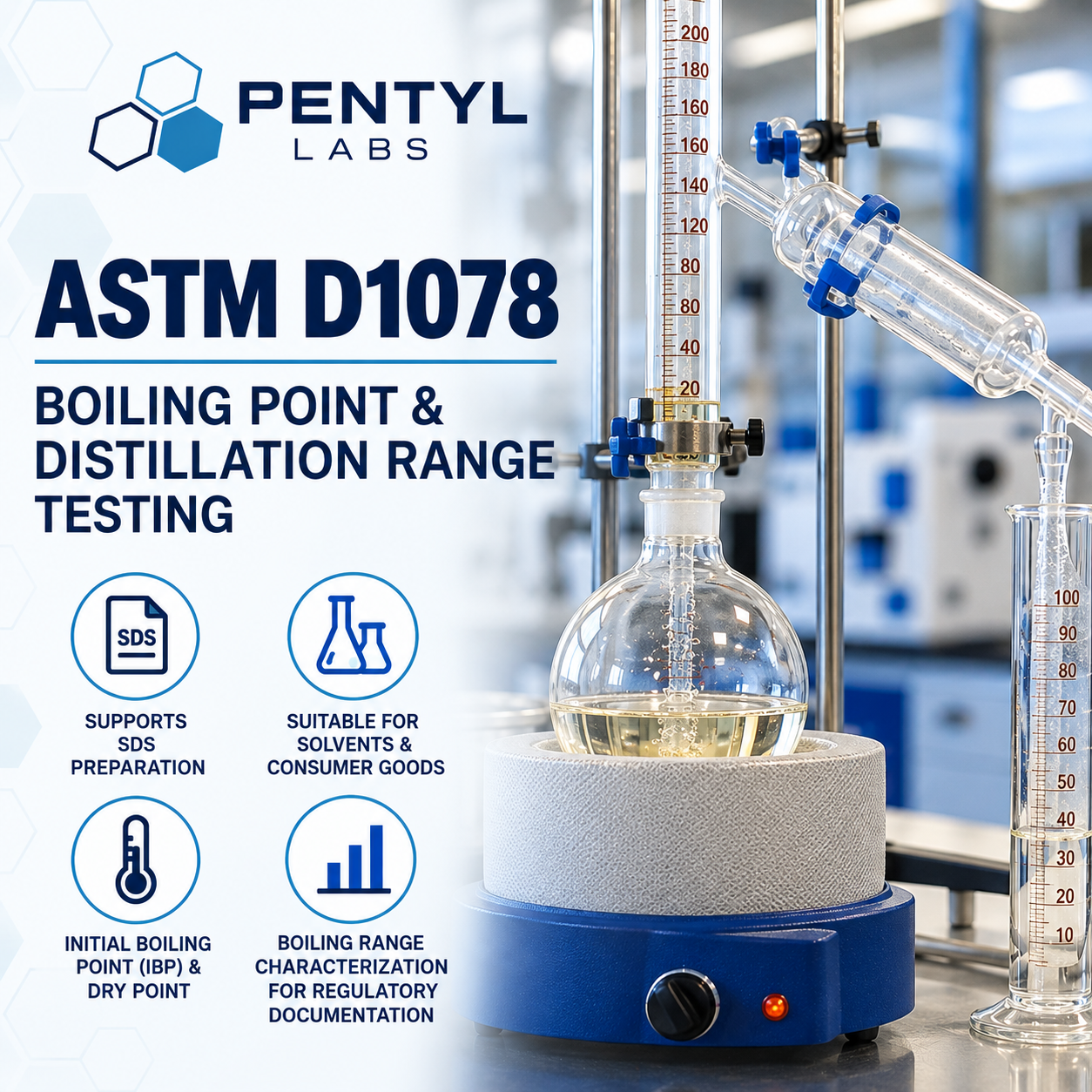
Pentyl Labs offers ASTM D1078 boiling point and distillation range testing for volatile organic liquids, solvents, and suitable consumer product formulations.
This method measures how a liquid boils and separates at different temperatures. As a result, manufacturers can better understand their products and evaluate important physical properties.
ASTM D1078 testing is commonly used to support Safety Data Sheet (SDS) preparation. In particular, the results help manufacturers report initial boiling point and boiling range information in Section 9 of an SDS.
In addition, ASTM D1078 provides useful data for product development, quality control, and regulatory assessments.
Testing Applications
ASTM D1078 testing supports a range of industrial and consumer product applications, including:
- SDS Preparation: Provides boiling point and boiling range data for Section 9 of an SDS.
- Consumer Product Testing: Supports suitable solvent-based cleaning products, fragrances, automotive care products, and other consumer goods.
- Solvent Testing: Measures boiling characteristics of applicable organic solvents and chemical mixtures.
- Regulatory Support: Provides analytical data for product safety reviews and applicable flammable liquid assessments.
- Product Development: Helps manufacturers evaluate raw materials and finished formulas.
- Quality Control: Allows manufacturers to compare results between production batches.
- Raw Material Testing: Helps confirm that materials meet product specifications.
Test Parameters
ASTM D1078 testing may provide several important results:
- Initial Boiling Point (IBP): The temperature at which the first drop of liquid collects during distillation.
- Distillation Temperature Profile: Temperatures recorded as different amounts of liquid collect.
- Dry Point: The temperature at which the last visible liquid evaporates from the distillation flask under the specified test conditions.
- Distillation Range: The temperature range observed during the test.
- Percent Recovery and Residue: Measurements that help describe the liquid’s distillation behavior.
Together, these results help manufacturers understand how a liquid behaves during heating.
Testing Method
ASTM D1078 – Standard Test Method for Distillation Range of Volatile Organic Liquids.
This method uses controlled heating and distillation to measure the boiling range of suitable volatile organic liquids.
OSHA specifically identifies ASTM D1078 as one method for determining initial boiling point when classifying flammable liquids.
Therefore, ASTM D1078 can provide useful data for SDS preparation and regulatory documentation.
However, not every liquid formula is suitable for this method. For example, some water-based products, complex mixtures, or materials outside the method’s scope may require another testing approach.
Pentyl Labs can help customers select the appropriate method based on their product composition and testing needs.
Alternative Boiling Point Testing Methods
Pentyl Labs also offers other boiling point and distillation testing options.
- ASTM D86 – Boiling Point & Distillation Range Testing: Commonly used for petroleum products, liquid fuels, and suitable petroleum-derived mixtures.
- ASTM D1120 – Boiling Point Testing: Primarily intended for engine coolants and applicable aqueous solutions.
Both ASTM D1078 and ASTM D86 are methods that OSHA specifically identifies for initial boiling point determination in flammable liquid classification.
These methods can support SDS preparation when they suit the material being tested.
Meanwhile, ASTM D1120 offers another option for certain liquid products.
Because formulas vary, our team can help determine which method best fits your testing requirements.
Why Choose Pentyl Labs?
Pentyl Labs provides analytical testing and technical support for manufacturers, formulators, distributors, and regulatory professionals.
We support businesses across the cosmetics, household products, consumer goods, automotive care, and specialty chemical industries.
Furthermore, our team helps customers select suitable test methods and understand their testing requirements.
Our services support:
- Safety Data Sheet (SDS) preparation
- Product safety reviews
- Quality control
- Product development
- Regulatory documentation
- Raw material testing
Contact Pentyl Labs today to request ASTM D1078 boiling point and distillation range testing or discuss the best testing method for your product.

