
What Is a Safe Harbor Assessment?
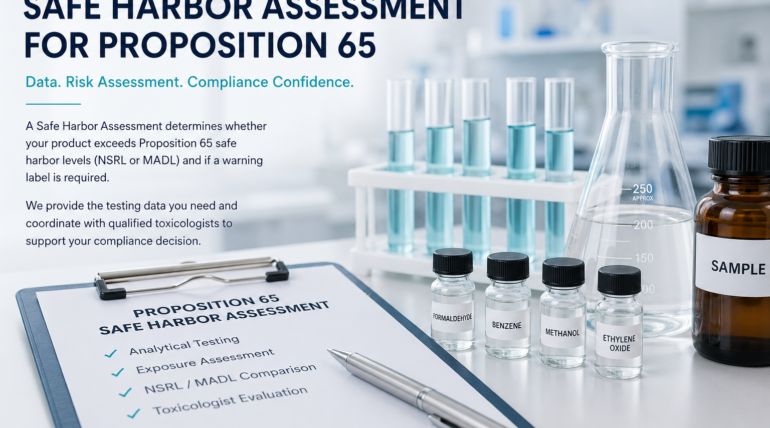
A Safe Harbor Assessment is a scientific and regulatory evaluation used to determine whether a product complies with California Proposition 65 without requiring a warning label.
This assessment compares the level of specific chemicals in your product against established exposure thresholds:
- NSRL (No Significant Risk Level) for carcinogens
- MADL (Maximum Allowable Dose Level) for reproductive toxins
If exposure remains below these levels, your product may qualify for a safe harbor, meaning no Proposition 65 warning is required.
When Do You Need a Safe Harbor Assessment?
You should consider a Safe Harbor Assessment if:
- Your product contains or may contain trace contaminants
- Testing detects substances listed under Proposition 65
- You plan to sell products in California
- A retailer, distributor, or legal team requests compliance verification
This is especially relevant for cosmetics, personal care products, and formulations with complex ingredient sourcing.
How Testing Data Is Used
A Safe Harbor Assessment begins with analytical testing to identify and quantify potential contaminants.
Common analytes include:
- Heavy metals such as lead, cadmium, and arsenic
- 1,4-dioxane
- Diethanolamine (DEA)
- Formaldehyde (free or released from preservatives)
- Methanol
- Benzene in certain product types
The detected concentration is then used to estimate consumer exposure, which is compared against Safe Harbor thresholds.
Analytical data alone does not determine compliance. Exposure assessment is the critical step.
Additional High-Risk Contaminants to Consider
Some risks arise from manufacturing processes or supply chain factors rather than formulation alone.
Ethylene Oxide and Related Compounds
Ethylene oxide is a Proposition 65 listed carcinogen typically associated with:
- Sterilization of packaging materials
- Treatment of raw materials
- Residual contamination in supply chains
It is not routinely tested in all products but may be evaluated in risk-based screening scenarios, particularly when supply chain exposure is possible.
Related compounds such as ethylene chlorohydrin or ethylene glycol may also be considered depending on the situation.
Common Outcomes of a Safe Harbor Assessment
After evaluation by a qualified toxicologist, your product will fall into one of three categories:
No Warning Required
Exposure levels are below Safe Harbor thresholds. The product can be sold in California without a Proposition 65 warning.
Warning Required
Exposure exceeds NSRL or MADL limits. A Proposition 65 warning label is required.
Reformulation or Mitigation Recommended
Exposure approaches or exceeds thresholds. Changes to formulation, sourcing, or packaging may reduce risk.
Why Testing Alone Is Not Enough
Laboratory results such as ppm or ppb do not directly determine regulatory compliance.
Two products with the same concentration can have different outcomes based on:
- Application type such as leave-on versus rinse-off
- Frequency and duration of use
- Amount applied per use
A Safe Harbor Assessment translates analytical data into a real-world exposure and risk evaluation.
Risk-Based Prop 65 Screening Approach
Not all Proposition 65 chemicals are relevant to every product.
A more effective approach is risk-based screening, where testing is tailored based on:
- Product formulation
- Ingredient sourcing
- Manufacturing processes
- Packaging materials
For example:
- Benzene may be relevant for aerosol products
- Methanol may be relevant for alcohol-based formulations
- Ethylene oxide may be relevant for sterilized packaging or certain raw materials
This targeted strategy improves efficiency while ensuring meaningful compliance coverage.
How Pentyl Labs Supports Safe Harbor Assessments
Pentyl Labs provides the analytical testing foundation required for Safe Harbor evaluations and coordinates with qualified toxicologists for formal assessment.
Our approach includes:
- Targeted, risk-based contaminant testing
- Clear reporting of detected levels
- Identification of relevant Proposition 65 chemicals
- Coordination with third-party toxicologists for exposure assessment
This allows clients to move from testing to interpretation to compliance decision with confidence.
Frequently Asked Questions
Can I rely on supplier data instead of testing?
Supplier data may not reflect final product conditions, contamination during manufacturing, or packaging-related exposure. Testing finished products provides a more reliable basis for assessment.
What if detected levels are very low?
Even trace levels may require evaluation. A Safe Harbor Assessment determines whether those levels exceed regulatory exposure thresholds.
Is a Safe Harbor Assessment required by law?
No, but it is the most widely accepted method to demonstrate compliance and reduce the risk of enforcement actions or unnecessary warning labels.
Get Started
If you are evaluating Proposition 65 compliance, Pentyl Labs can help generate the data needed for a Safe Harbor Assessment and connect you with qualified experts for final evaluation.
Contact [email protected]

