

Requirements Explained for Cosmetic Products
The National Eczema Association (NEA) Seal of Acceptance is one of the most recognized third-party endorsements for products intended for sensitive and eczema-prone skin. For brands looking to build trust and differentiate in the market, achieving this seal can be a strong signal of product safety and suitability.
This article explains what the NEA Seal of Acceptance is, what requirements are typically involved, and how testing such as HRIPT fits into the process.
What Is the NEA Seal of Acceptance
The NEA Seal of Acceptance is a voluntary program that evaluates products for their suitability for individuals with eczema or sensitive skin.
Products that earn the seal are reviewed for:
- Ingredient safety
- Irritation potential
- Overall formulation suitability for eczema-prone skin
The program is designed to help consumers identify products that are less likely to trigger irritation or flare-ups.
Is the NEA Seal Required
No. The NEA Seal of Acceptance is not a regulatory requirement.
However, it is often pursued by brands that want to:
- Build credibility with sensitive skin consumers
- Differentiate in a crowded skincare market
- Support claims related to eczema or irritation
- Increase retailer and consumer confidence
Key Requirements for NEA Seal of Acceptance
While exact requirements can vary by product category, the evaluation process generally includes:
1. Ingredient Review
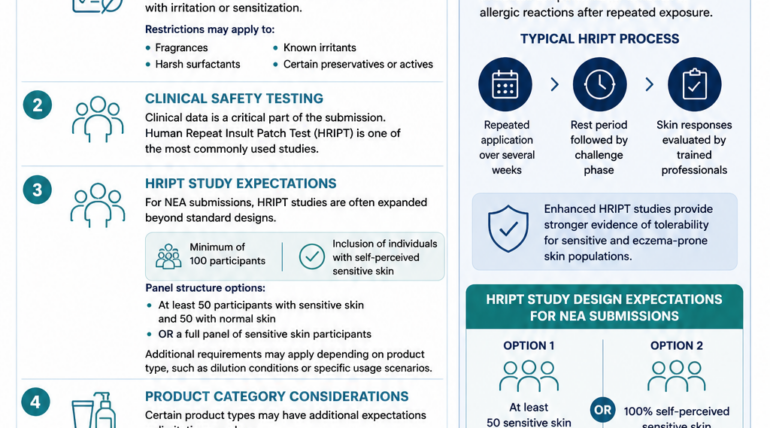
Formulations are reviewed to ensure they do not contain ingredients that are commonly associated with irritation or sensitization.
Restrictions may apply to:
- Fragrances
- Harsh surfactants
- Known irritants
- Certain preservatives or actives
The focus is on minimizing risk for eczema-prone skin.
2. Clinical Safety Testing
Clinical data is a critical part of the submission.
One of the most commonly used studies is:
- Human Repeat Insult Patch Test (HRIPT)
For eczema-focused submissions, more robust study designs may be expected.
3. HRIPT Study Expectations
For programs such as the NEA Seal of Acceptance, HRIPT studies are often expanded beyond standard designs.
These studies may include:
- A minimum of 100 participants
- Inclusion of individuals with self-perceived sensitive skin
- Panel structures such as:
- At least 50 participants with sensitive skin and 50 with normal skin
- Or a full panel of sensitive skin participants
Additional requirements may apply depending on the product type, such as dilution conditions or specific usage scenarios.
These enhanced studies provide stronger evidence that the product is well tolerated by sensitive populations.
4. Product Category Considerations
Certain product types may have additional expectations or limitations.
Examples may include:
- Cleansers requiring dilution during testing
- Restrictions on exfoliating products
- Specific requirements for sunscreens or medicated products
These conditions are intended to reflect real-world use and minimize irritation risk.
5. Documentation and Review
To obtain the seal, brands typically submit:
- Full ingredient list
- Safety and toxicological data
- Clinical study reports
- Product usage information
Submissions are reviewed by qualified professionals to determine whether the product meets the program’s criteria.
Why HRIPT Plays a Key Role
HRIPT is one of the most widely accepted methods for evaluating irritation and sensitization potential.
For NEA-related submissions, expanded HRIPT studies:
- Provide stronger evidence of tolerability
- Address sensitive skin populations directly
- Support claims related to eczema-prone skin
While HRIPT does not guarantee zero irritation, it significantly reduces uncertainty and strengthens product positioning.
Benefits of the NEA Seal of Acceptance
Achieving the NEA Seal of Acceptance can provide several advantages:
- Increased consumer trust
- Differentiation in sensitive skin categories
- Stronger retail positioning
- Additional credibility for marketing claims
For brands targeting eczema-prone consumers, the seal can be a meaningful competitive advantage.
Do All Products Need This Level of Testing
No. Many cosmetic products do not require NEA-level testing.
However, pursuing the seal may be beneficial if:
- Your brand focuses on sensitive or compromised skin
- You want to support stronger safety claims
- You are targeting premium or clinical positioning
Choosing the right level of testing depends on your product strategy and market goals.
Final Thoughts
The National Eczema Association Seal of Acceptance represents a higher standard of product evaluation for sensitive and eczema-prone skin. While not required, it can be a valuable tool for brands looking to build trust and credibility.
Robust clinical testing, including enhanced HRIPT studies, plays a central role in supporting these submissions and demonstrating product safety.
50 Subject HRIPT Testing – Normal Skin
50 Subject HRIPT Testing – Sensitive Skin
NEA_SealofAcceptance_ClinicalTrialGuidelines_D03.pdf

