

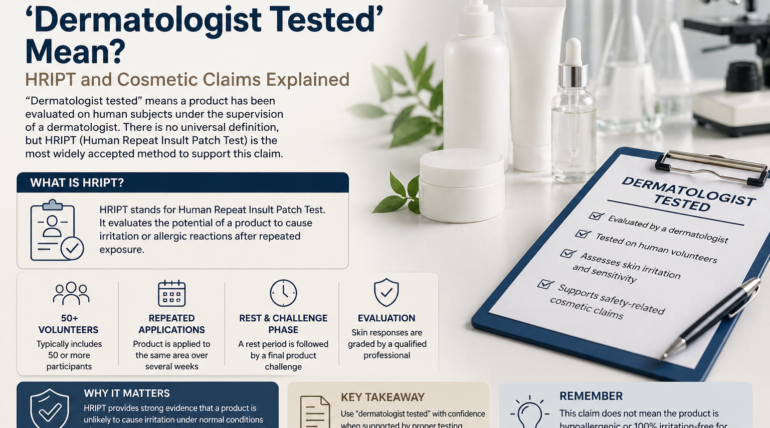
HRIPT and Cosmetic Claims Explained
The claim “dermatologist tested” appears on a wide range of cosmetic products, from skincare to personal care items. While it sounds authoritative, the meaning is often misunderstood. This article explains what “dermatologist tested” actually means, how HRIPT fits into this claim, and what brands need to know to support it properly.
What Does “Dermatologist Tested” Mean
At its core, “dermatologist tested” means that a product has been evaluated on human subjects under the supervision of a dermatologist.
However, there is no single regulatory definition that standardizes this claim. This means:
- The type of testing can vary
- The number of participants can vary
- The study design can vary
Because of this flexibility, the claim alone does not guarantee safety, hypoallergenicity, or effectiveness. It simply indicates that a dermatologist was involved in some level of product testing.
What Is HRIPT
HRIPT stands for Human Repeat Insult Patch Test. It is one of the most commonly used studies to support safety-related claims in cosmetics.
HRIPT is designed to evaluate whether a product has the potential to cause skin irritation or allergic reactions after repeated exposure.
How HRIPT Works
A typical HRIPT study includes:
- 50 or more human volunteers
- Repeated application of the product to the same skin site over several weeks
- A rest period followed by a challenge phase
- Evaluation of skin responses by a qualified professional
Reactions are graded on a standardized scale, usually from no reaction to severe irritation.
Why HRIPT Matters for Claims
HRIPT is often used to support claims such as:
- Dermatologist tested
- Dermatologically tested
- Skin tested
- Suitable for sensitive skin
- Non-irritating
While HRIPT does not prove that a product is completely risk-free, it provides strong evidence that the product is unlikely to cause irritation under normal conditions of use.
For many brands, HRIPT is considered the gold standard for supporting “dermatologist tested” claims.
Can You Use “Dermatologist Tested” Without HRIPT
Technically, yes. A product can be evaluated by a dermatologist in other ways, such as a smaller patch test or clinical observation.
However, using the claim without robust supporting data can create risk:
- Retailers may request supporting documentation
- Regulatory bodies may challenge the claim if it is misleading
- Consumers may expect a higher level of validation
For these reasons, HRIPT is widely recommended when making this claim.
What Regulators and Retailers Expect
In the United States, cosmetic claims must be truthful and not misleading. While there is no requirement to perform HRIPT specifically, companies must be able to substantiate their claims.
Retailers and platforms may also request:
- Study summaries
- Number of participants
- Confirmation of dermatologist involvement
- Final report documentation
Without proper substantiation, products may face listing delays or removal.
Common Misconceptions
“Dermatologist Tested” Means Hypoallergenic
This is not necessarily true. Hypoallergenic is a separate claim that requires its own justification.
“Dermatologist Tested” Means No Irritation
Even well-tested products can cause reactions in some individuals. HRIPT reduces risk but does not eliminate it.
“Dermatologist Tested” Is Regulated
There is no strict global standard defining how this claim must be used.
Best Practices for Brands
To use “dermatologist tested” confidently and responsibly:
- Conduct a properly designed HRIPT study
- Use a sufficient number of participants, typically around 50
- Ensure dermatologist oversight and documentation
- Maintain full reports for claim substantiation
- Avoid overstating the results
Clear, accurate claims build trust and reduce regulatory risk.
Final Thoughts
“Dermatologist tested” is a valuable claim, but only when it is backed by meaningful data. HRIPT provides a reliable and widely accepted way to support this claim and demonstrate product safety.
For brands looking to build credibility, meet retailer expectations, and reduce risk, investing in proper testing is an important step.

