

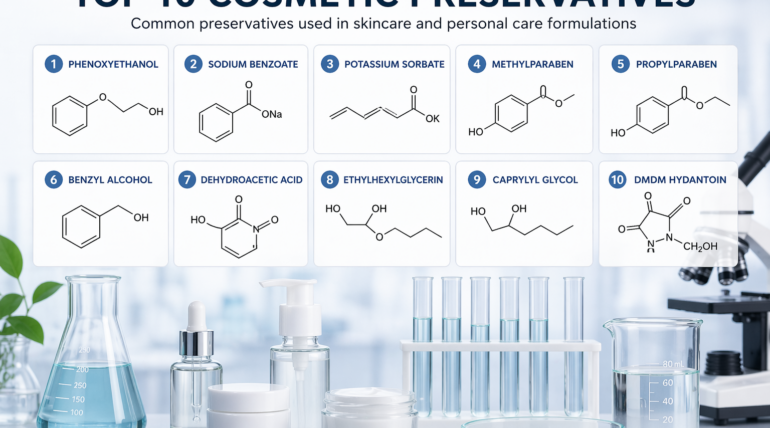
Preservatives are essential in cosmetic and personal care products to prevent the growth of bacteria, yeast, and mold. Without an effective preservative system, products can become unsafe or unstable over time.
While many preservative options exist, most formulations rely on a core group of widely used ingredients. Below are ten of the most common cosmetic preservatives and how they are typically used.
1. Phenoxyethanol
Phenoxyethanol is one of the most widely used preservatives globally. It provides broad-spectrum protection, particularly against bacteria, and is stable across a wide pH range.
It is commonly used in lotions, creams, serums, and wipes, often in combination with other ingredients to enhance overall preservation.
2. Sodium Benzoate
Sodium benzoate is a common preservative in water-based and “clean label” formulations. It is most effective in acidic systems, typically below pH 5.5.
It is frequently used in cleansers, shampoos, and natural-leaning products, often paired with potassium sorbate.
3. Potassium Sorbate
Potassium sorbate is particularly effective against yeast and mold. Like sodium benzoate, it performs best in acidic conditions.
It is commonly used in combination systems to improve overall preservative coverage in creams, emulsions, and water-based products.
4. Methylparaben
Methylparaben has historically been one of the most effective and reliable preservatives. It offers broad-spectrum protection and strong stability.
Although still used in some markets, its use has declined due to consumer perception concerns.
5. Propylparaben
Propylparaben is often used alongside methylparaben to enhance protection, particularly against mold and yeast.
Together, these ingredients provide a highly effective and well-balanced preservative system.
6. Benzyl Alcohol
Benzyl alcohol serves as both a preservative and a solvent. It has moderate antimicrobial activity and is commonly used in “paraben-free” and natural formulations.
It is often combined with other preservatives to improve overall effectiveness.
7. Dehydroacetic Acid
Dehydroacetic acid is commonly used in natural or eco-certified products. It is typically paired with benzyl alcohol to create a broad-spectrum system.
This combination is frequently seen in clean beauty formulations.
8. Ethylhexylglycerin
Ethylhexylglycerin is not a strong preservative on its own but is widely used as a preservative booster. It enhances the effectiveness of other preservatives, particularly phenoxyethanol.
It also contributes to improved skin feel in finished products.
9. Caprylyl Glycol
Caprylyl glycol is another multifunctional ingredient that provides antimicrobial support. It is often used alongside other preservatives to strengthen the system.
It is commonly found in modern formulations, especially those positioned as “clean” or “alternative.”
10. DMDM Hydantoin
DMDM hydantoin is a formaldehyde-releasing preservative that provides effective microbial control at low concentrations.
While still used in some rinse-off products, it has become less common due to regulatory and consumer concerns.
Key Considerations
Most cosmetic products do not rely on a single preservative. Instead, they use combinations designed to provide broad-spectrum protection.
The effectiveness of a preservative system depends on several factors, including pH, water content, formulation type, and packaging.
Why Testing Is Important
Even commonly used preservatives must be verified through testing.
Preservative assays confirm that the correct concentration is present in the product. Preservative efficacy testing evaluates whether the system effectively protects against microbial growth.
Both types of testing are important for ensuring product safety, stability, and regulatory compliance.
Final Thoughts
Preservatives are a critical component of any cosmetic formulation. Selecting the right system is only part of the process. Verifying that it performs as intended is essential to delivering a safe and reliable product.

