

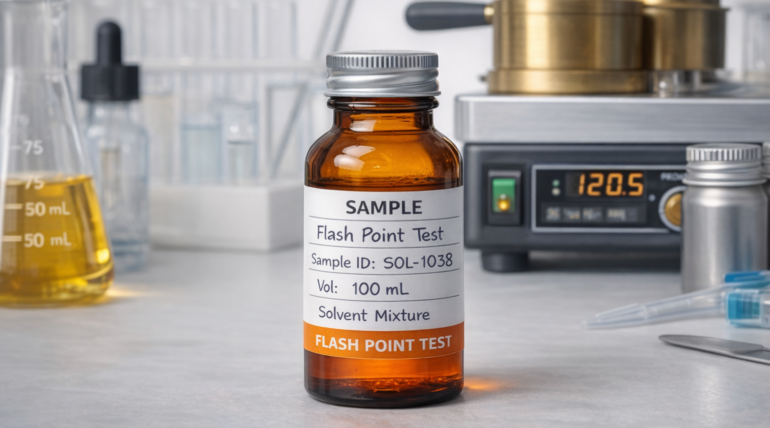
Flash point testing determines the temperature at which a liquid produces vapors that ignite when exposed to an ignition source. Because accurate measurements depend on proper sample handling, laboratories require specific sample preparation and volume requirements before performing the test.
Understanding flash point testing sample requirements helps ensure reliable results and prevents delays in laboratory analysis.
Why Proper Sample Preparation Matters
Flash point measurements depend on controlled laboratory conditions. If the submitted sample is contaminated, improperly stored, or insufficient in volume, the test may produce unreliable results.
Therefore, laboratories request properly prepared samples to ensure:
- accurate flash point measurement
- consistent laboratory conditions
- reliable safety data
- regulatory compliance
In many cases, improper sampling is the most common cause of testing delays.
Typical Sample Volume for Flash Point Testing
Most laboratories performing ASTM D93 Pensky-Martens closed cup testing require approximately:
50–100 mL minimum liquid sample
However, submitting a slightly larger amount allows the laboratory to perform repeat testing if necessary.
Recommended submission amount:
| Test Method | Recommended Sample Volume |
|---|---|
| ASTM D93 | 100–250 mL |
| ASTM D56 | 50–100 mL |
| ASTM D92 | 75–150 mL |
Providing sufficient sample volume ensures the laboratory can perform testing without sample limitations.
ASTM standards are published by ASTM International, which develops standardized testing procedures for materials and chemicals.
https://www.astm.org
Recommended Sample Containers
To maintain sample integrity, liquids should be submitted in containers that prevent evaporation or contamination.
Common acceptable containers include:
- glass bottles with sealed caps
- metal solvent containers
- high-density polyethylene (HDPE) bottles
Containers should be tightly sealed to prevent solvent vapor loss before testing.
Volatile solvents can evaporate quickly. Consequently, improper containers may alter the measured ignition temperature.
Sample Condition Requirements
Before submitting a sample for flash point testing, ensure the material meets the following conditions:
- the liquid should be homogeneous
- the sample should be free of debris or contamination
- the container should be properly labeled
- the product should represent the final formulation
If the material contains multiple phases or suspended solids, laboratories may need additional preparation steps.
Information Required for Flash Point Testing
Providing additional product information helps laboratories determine the appropriate test method.
Typical information requested includes:
- product name or description
- approximate expected flash point (if known)
- solvent composition (if available)
- sample hazard classification
Although the flash point may be unknown, providing approximate solvent composition helps laboratories select the most appropriate testing conditions.
Products That Commonly Require Flash Point Testing
Flash point testing is frequently required for products containing volatile organic solvents.
Examples include:
- adhesives
- coatings and paints
- cleaning solvents
- fragrances and essential oils
- chemical intermediates
Many manufacturers must determine the ignition temperature before shipping or distributing these products.
For example, the U.S. Occupational Safety and Health Administration (OSHA) classifies flammable liquids partly based on flash point measurements.
https://www.osha.gov/flammable-liquids
Flash Point Testing at Pentyl Labs
Pentyl Labs provides flash point testing using the ASTM D93 Pensky-Martens closed cup method for solvents, adhesives, fragrance materials, and chemical products.
Typical testing requirements include:
- liquid sample submission
- approximately 100–250 mL sample volume
- sealed container to prevent evaporation
Results are provided in a formal laboratory report suitable for safety documentation and product evaluation.
For testing inquiries, contact:

