

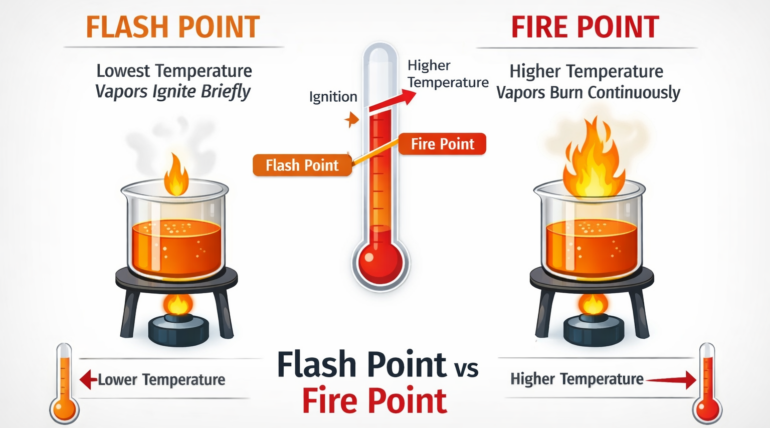
Flash point and fire point are two important measurements used to evaluate the flammability of liquids. Although these terms are often confused, they describe different ignition behaviors.
Understanding the difference helps manufacturers, safety professionals, and regulators determine how a material should be handled, transported, and classified.
What Is Flash Point?
Flash point is the lowest temperature at which a liquid produces enough vapor to ignite momentarily when exposed to an ignition source.
At this temperature, vapors above the liquid can briefly ignite. However, the flame does not continue to burn because vapor production is still too low to sustain combustion.
Laboratories measure this property using standardized methods such as ASTM D93 Pensky-Martens closed cup testing.
ASTM standards are developed by ASTM International to ensure consistent testing practices.
https://www.astm.org
If you want a deeper explanation of the measurement itself, see our article explaining what flash point means.
What Is Flash Point? Definition, Testing Methods, and Safety
What Is Fire Point?
Fire point is the temperature at which vapors continue to burn for at least five seconds after ignition.
At this stage, the liquid produces enough vapor to support sustained combustion.
Because the vapor concentration must be higher, fire point always occurs at a higher temperature than flash point.
Key Differences Between Flash Point and Fire Point
Although the two measurements are closely related, they represent different levels of flammability.
| Property | Flash Point | Fire Point |
|---|---|---|
| Definition | Temperature where vapors ignite momentarily | Temperature where vapors sustain combustion |
| Combustion | Brief ignition | Continuous burning |
| Temperature | Lower | Higher |
| Testing Methods | ASTM D93, ASTM D56 | ASTM D92 |
Therefore, flash point indicates initial ignition risk, while fire point represents sustained burning conditions.
How Flash Point and Fire Point Are Measured
Laboratories measure these properties using controlled heating and ignition tests.
During testing:
- The laboratory places the liquid sample in a test cup.
- The instrument gradually heats the sample.
- An ignition source is introduced periodically.
- The operator observes whether vapors ignite.
When ignition occurs briefly, the temperature is recorded as the flash point.
If the liquid continues to burn for at least five seconds, the recorded temperature becomes the fire point.
Common Test Methods
Different standardized methods measure ignition temperatures depending on the product type.
ASTM D93 — Pensky-Martens Closed Cup
ASTM D93 is widely used for:
- solvents
- adhesives
- coatings
- chemicals
This method uses a closed cup apparatus that traps vapors above the liquid.
ASTM D92 — Cleveland Open Cup
ASTM D92 measures both flash point and fire point using an open cup apparatus.
This method is commonly used for:
- petroleum oils
- lubricants
- materials with higher ignition temperatures
Because the test cup remains open to air, measured values are typically higher than closed-cup methods.
Why These Measurements Matter
Flash point and fire point are critical for determining:
- flammable liquid classifications
- transportation regulations
- hazard labeling
- safe storage conditions
For example, the U.S. Occupational Safety and Health Administration (OSHA) uses flash point values to classify flammable liquids.
https://www.osha.gov/flammable-liquids
Consequently, accurate laboratory testing helps companies ensure regulatory compliance and workplace safety.
Industries That Use Flash Point and Fire Point Testing
Many industries rely on these measurements, including:
- chemical manufacturing
- adhesives and coatings
- petroleum products
- cosmetics and fragrances
- industrial solvents
Any product containing volatile organic solvents may require ignition temperature testing.
Flash Point Testing at Pentyl Labs
Pentyl Labs provides ASTM D93 flash point testing services for chemical products, solvents, adhesives, and fragrance materials.
Testing supports:
- safety data sheet preparation
- hazard classification
- regulatory documentation
- product safety evaluations
For flash point testing inquiries, contact:

